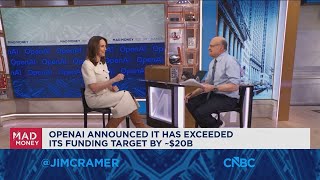
Mad Money 03/24/26 | Audio Only
Speakers
Jim Cramer
— Host, Mad Money
Sarah Frier
— CFO, OpenAI
Summary
- Conflicting narratives around the Middle East war create a chaotic market: oil stocks rally on troop deployment signals while consumer/financial stocks rise on peace rhetoric, making coherent trading nearly impossible.
- A major, under-discussed battle is the disruption of legacy enterprise software companies (e.g., Microsoft, Salesforce, Workday) by AI-native private firms like OpenAI, Anthropic, and Databricks.
- OpenAI, with 900M weekly active users and 50M subscribers, raised over $120B at an ~$840B valuation. It is shifting from 60/40 consumer/enterprise revenue split towards 50/50 as enterprises adopt its "Frontier" platform for full business transformation.
- OpenAI's growth is constrained by a "vertical wall of demand" for compute, forcing hard prioritization decisions (e.g., holding back Sora video model) and requiring unprecedented capital investment.
- AI's impact on labor is framed as a choice: Jack Dorsey's view (AI enables drastic headcount reduction at Block) vs. Jensen Huang's view (AI is a force multiplier; firing represents a "failure of imagination"). Cramer sides with the latter, expecting productive integration.
- The Fundrise Innovation Fund (VCX) skyrocketed over 1000% post-listing due to an artificially low float (only ~10% of shares unlocked), not fundamentals, trading at over 16x its stated Net Asset Value (NAV) of ~$19.
- The Robin Hood Ventures Fund is a more traditional IPO but trades closer to its NAV (~$25.31); Cramer is not enthusiastic but views it as more rationally priced than VCX.
- A key risk for AI companies is regulatory and public trust; OpenAI's strategy is to democratize access and demonstrate tangible benefits (e.g., in healthcare) to build societal trust pre-emptively.
- OpenAI is exploring consumer hardware (multimodal devices) for release late this year/early next and is taking initial steps to provide retail investor access ahead of a potential future public listing.
Ideas
Caller asked if LMT is a buy after being down 15%. Cramer responded, "Lockheed? Oh, no. Lockheed is if the war's over, we're not going to want our own locked. The president seem to indicate the war's kind of over. So, let's leave it at that." The investment thesis for defense contractors is tied to ongoing conflict. If the administration's messaging suggests the war is ending, demand for weaponry and thus Lockheed's business prospects decline. The stock should be avoided because the primary catalyst (war-driven demand) appears to be fading based on presidential commentary. Geopolitical situation escalates again, contradicting peace rhetoric and reigniting defense spending.
Cramer listed companies like Microsoft, Salesforce, and Workday as being in the "house of pain" and stated, "as an equity analyst, I don't think you could be recommending them." These legacy enterprise software companies are being directly challenged and disintermediated by AI-native private competitors (OpenAI, Anthropic, Databricks), creating fundamental uncertainty and negative investor sentiment. The sector faces a disruptive threat that currently outweighs its profitability, warranting an avoid recommendation until the competitive landscape clarifies. The incumbents successfully integrate AI and defend their market positions faster than anticipated.
Cramer said, "you'd have to be crazy to buy the Fundrise Innovations Fund up here... at its current price of $315, VCXS is trading at over 16 times its NAV... That is pure lunacy." The fund's market price is massively disconnected from the value of its underlying assets (16x NAV). The price spike is driven by mechanical factors (low float, lockups), not fundamentals. The extreme overvaluation relative to NAV makes it a clear avoid; a sharp correction is expected when lockups expire. The NAV calculations severely underestimate the value of the private holdings, or demand remains insatiable post-lockup.
Cramer said, "this was a very hot stock and somehow it lost its mojo. I don't know how it's going to get the mojo back and right now it sells at too high a price to earnings multiple. I'm going to have to say I don't like the stock." The loss of positive momentum ("mojo") combined with a high valuation multiple removes the rationale for investment. The stock is unattractive and should be avoided due to unfavorable price momentum and valuation. The company reignites exceptional demand or brand prestige that justifies its premium multiple.
Cramer said, "I find that the Bulls are right. I find that that Anthony Notto is right. I've known Anthony Notto since 1998. I never question his character and I'm a believer in SoFi." This followed the caller citing strong quarterly results and CEO share purchases. Despite controversy around the stock, Cramer's long-term trust in the CEO's character and his assessment of the company's fundamental progress (record revenue, profitability) override the negative narrative. The positive fundamental trajectory and leadership warrant a bullish stance. The broader negative sentiment or sector-specific headwinds overpower the company's execution.