Trump Threatens Escalation in Iran | Open Interest 3/26/2026
Speakers
Dani Burger
— Anchor, Bloomberg Television
Wayne Sanders
— Senior Defense Research Analyst, Bloomberg Intelligence
Caroline Hyde
— Co-Anchor, Bloomberg Tech
Katherine Doherty
— Finance Reporter, Bloomberg
Bruce Douglas
— Reporter, Bloomberg
Dana D'Auria
— Co-Chief Investment Officer, Envestnet
Mandeep Singh
— Senior Analyst, Bloomberg Intelligence
Will Kennedy
— EMEA News Director, Bloomberg
Becca Wasser
— Senior Fellow, CNAS
Aoifinn Devitt
— Global Managing Director, Moneta Group
Oliver Crook
— Chief European Correspondent, Bloomberg
Dana Stroul
— Research Director, Washington Institute for Near East Policy
Donald Trump
— President of the United States
Summary
- President Trump escalates rhetoric, warning Iran to "get serious" and suggesting a potential final large-scale military campaign to end the war, increasing geopolitical uncertainty.
- Several analysts (Dana D'Auria, Aoifinn Devitt, Becca Wasser) argue markets are underpricing the risk of a prolonged conflict, which could sustain higher oil prices, delay Fed rate cuts, and create longer-term supply chain disruptions.
- Google announces its "Turbo Quants" technology can compress memory needed for AI models by a factor of six, sparking a second day of selling in memory chip stocks like Micron, though analysts question the near-term material impact.
- Jefferies posts Q1 results with a record investment banking quarter overshadowed by write-downs on credit bets and a telecom investment, highlighting ongoing credit market anxieties.
- Lloyd Blankfein warns of a "fire" risk in private markets, citing overvalued, illiquid assets where a single spark could trigger widespread markdowns; an Ares fund posts its worst monthly loss.
- The OECD sharply raises its 2026 U.S. inflation forecast to 4.2%, citing oil price shocks from the Iran war as a significant downside risk to global growth.
- Google and Meta are found liable in a landmark social media addiction case; while fines are minimal, analysts see rising regulatory headline risk and potential for a broader "tobacco moment" for the industry.
- Discussion on private credit stresses reveals concerns over low recovery rates for SaaS-based loans and potential spillover into leveraged loans, but also views that risks are idiosyncratic, not systemic.
- Traditional safe havens like gold are failing to perform during the current crisis, leading investors like Dana D'Auria to advocate for diversification across equities and fixed income rather than singular hedges.
- Iran claims sovereignty over the Strait of Hormuz, which analysts see as a major obstacle to any ceasefire deal and a factor that will keep shipping costs and oil price risk elevated even if hostilities formally end.
Ideas
The speaker asks if the social media addiction liability case is a "tobacco moment" for the companies and states they will face "knock after knock, headline after headline" from thousands of similar claims. A legal precedent has been set (10 jurors found platforms liable for mental health addiction). This opens the door for a wave of litigation from individuals, schools, and states. Regulatory momentum is also building in the US, EU, and Australia to restrict youth social media use. WATCH for escalating legal and regulatory headline risk that could pressure the social media advertising business model and force costly platform changes, even if individual case fines are small. Courts overturn the precedent on appeal, or the companies successfully settle the bulk of claims en masse without admitting guilt.
The speaker states that Jefferies' strong investment banking and equity trading numbers are being "overshadowed" by write-downs on credit bets and an unrelated telecom investment. The company had its best investment banking quarter ever, showing core strength. However, credit losses, while disclosed, create "noise" and exacerbate existing market jitters about credit quality, capping positive momentum in the stock. NEUTRAL due to mixed signals. The record advisory/underwriting performance is a clear positive, but it is counterbalanced by tangible credit losses that validate broader sector fears. Credit markets stabilize, allowing the core investment banking strength to become the dominant narrative for the stock.
The speaker notes that if you're worried about private credit, you should also worry about leveraged loans and private equity, undermining the argument that private credit is a less correlated asset class. The defense of private credit performance is that it's doing as poorly as other risk asset classes, which negates its purported low-correlation, illiquidity premium. Stresses in credit (senior) logically feed upstream to equity (junior) in capital structures. AVOID the asset class due to diminishing unique value proposition (low correlation premium), rising credit quality concerns (especially in SaaS loans with low recovery value), and visible liquidity stresses (gates, redemptions). A swift economic recovery that improves software company fundamentals and allows for orderly exits, preserving the illiquidity premium narrative.
The speaker assesses that there is no good plan to end the Iran conflict, and a short-term oil supply shock could become long-term if the war persists, impacting Fed policy and company fundamentals. A protracted war means sustained disruption to the Strait of Hormuz and energy flows, keeping oil prices structurally higher for months. This feeds into sticky inflation, preventing the Fed from cutting rates even amid a weakening labor market. WATCH because the duration of the conflict is the critical unknown variable. If it extends, oil prices and broader market impacts will be significantly worse than currently priced. A swift, decisive military or diplomatic conclusion to the war that quickly re-opens shipping lanes.
The speaker explicitly states that the selloff in memory names due to Google's memory compression technology is not warranted because the sector is "so undersupplied." Google's efficiency gains are real, but total AI-driven demand for memory is immense and growing. Supply-demand imbalance remains huge, and edge devices will need more memory regardless of hyperscaler efficiency. WATCH the memory sector (using MICRON as the named proxy) for a potential overreaction. The selloff may present an opportunity if the fundamental supply shortage thesis holds. Google's technology is adopted industry-wide faster than expected, leading to a permanent step-down in memory demand growth from large AI models.
Up Next

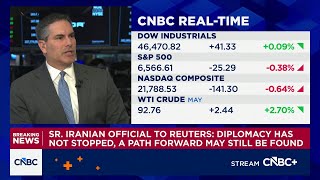


This Bloomberg Markets video, published March 26, 2026, features Caroline Hyde, Katherine Doherty, Bruce Douglas, Dana D'Auria, Mandeep Singh discussing GOOG, META, JEF, BIZD, WTI, MU. 5 trade ideas extracted by AI with direction and confidence scoring.
Speakers: Caroline Hyde, Katherine Doherty, Bruce Douglas, Dana D'Auria, Mandeep Singh · Tickers: GOOG, META, JEF, BIZD, WTI, MU