War Fuels Inflation, Tanks Sentiment Ahead of US, Iran Talks |Bloomberg Businessweek Daily 4/10/2026
Speakers
Ira Jersey
— Bloomberg Intelligence Chief US Interest Rate Strategist
Greg Daco
— Chief Economist, EY-Parthenon
Humayun Tai
— Senior Partner and Leader of Global Energy & Materials Practice, McKinsey & Company
Todd Gillespie
— Banking Reporter, Bloomberg News
Summary
- Headline CPI surged 0.9% MoM (3.3% YoY) in March, the largest jump in nearly four years, driven primarily by skyrocketing gasoline prices due to the Iran war.
- Greg Daco argues the energy shock is layered on top of prior supply constraints, making inflation more persistent ("longer tail") than a simple transitory spike. He raised his year-end core PCE forecast to 3%.
- Daco and Ira Jersey agree the Fed will be on hold, with near-zero chance of a cut unless the labor market breaks (e.g., 3 months of negative payrolls). The Fed's hard 2% target creates policy awkwardness if inflation sticks at 3%.
- Daco highlights a severe consumer income squeeze: real disposable income growth (~1%) lags consumer spending growth (~2%), financed by savings/credit. The energy shock (~$350/household) outweighs larger tax refunds (~$290/household), disproportionately hurting lower-income households.
- Humayun Tai states the Strait of Hormuz closure has structurally reconfigured energy supplies, especially for Asia. Physical supply constraints will create price stickiness; a cease-fire doesn't immediately resolve logistical bottlenecks.
- Tai outlines a 6-week inflection point: Asian manufacturing reserves will deplete, leading to spot contract repricing. Full resolution could take 12+ weeks due to delivery lags and insurance/legal complexities.
- Second-order inflation effects from higher fertilizer and chemical costs are expected to flow through to food prices over the coming months.
- Despite high oil prices (~$100/bbl), Tai observes client hesitancy to invest in new oil & gas drilling and even Asian manufacturing facilities, indicating a third-order economic dampening effect.
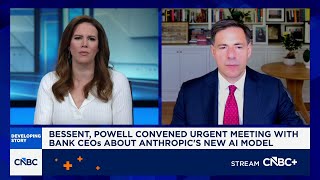
- Todd Gillespie reports urgent, confidential meetings between top U.S. regulators (Powell, Bessent) and major bank CEOs over systemic cyber risks posed by Anthropic's new AI model, which can detect extreme vulnerabilities in security systems.
- The concern extends beyond Anthropic's tool to potential replication by adversarial states (China, Russia, Iran), prompting a top-down directive for banks to evaluate defenses and potentially leading to new regulations.
Ideas
The consumer is under an "income squeeze" with spending outpacing income growth, financed by savings/credit. The ~$350/household oil price shock negates the benefit of larger tax refunds, disproportionately impacting lower-income consumers. Lower-income households, which spend a higher portion of income on essentials like fuel and food, will be forced to pull back on discretionary spending. This strains broader economic momentum. AVOID the consumer non-durables sector (e.g., everyday goods) due to impending pressure on volume and pricing power as the most sensitive consumer cohort retrenches. A rapid decline in energy prices or a stronger-than-expected labor market could bolster consumer resilience.
U.S. Treasury Secretary and Fed Chair urgently summoned major bank CEOs over concerns that Anthropic's latest AI model introduces a "whole new level of cyber risk" by detecting extreme vulnerabilities in systems like web browsers. This AI capability, and the potential for it to be replicated by adversarial states, presents a systemic risk to the core financial infrastructure. Banks are being directed to test and evaluate these risks internally. WATCH due to the high-level regulatory concern and the potential for this to catalyze new cybersecurity rules, increased compliance costs, and operational scrutiny for the financial sector. The risk is mitigated if banks and regulators successfully develop and implement defensive frameworks before the technology is widely weaponized.
Humayun Tai
Senior Partner and Leader of Global Energy & Materials Practice, McKinsey & Company
35:52
The Strait of Hormuz closure has "structurally reconfigured" global energy supplies, creating physical bottlenecks. Even with a cease-fire, logistical issues (e.g., 1300 queued ships, insurance premiums, legal costs) will cause a protracted 12-week+ resolution. The physical supply/demand disconnect (spot prices at $145 vs. futures at $100) will only dissipate slowly as logistics untangle. This creates persistent price stickiness and a risk premium. WATCH due to the high likelihood of sustained price volatility and elevated levels ($75-$80 by year-end per Greg Daco) even after a geopolitical resolution, driven by slow-moving physical logistics. A faster-than-expected normalization of shipping traffic and a swift drop in insurance premiums could cause prices to fall more rapidly.
Up Next



This Bloomberg Markets video, published April 10, 2026, features Greg Daco, Todd Gillespie, Humayun Tai discussing XLP, XLF, WTI. 3 trade ideas extracted by AI with direction and confidence scoring.
Speakers: Greg Daco, Todd Gillespie, Humayun Tai · Tickers: XLP, XLF, WTI