How to trade the Iran war uncertainty
Speakers
Josh Brown
— CEO, Ritholtz Wealth Management
Malcolm Ethridge
— CIC Wealth Executive Vice President
Steve Weiss
— Chief Investment Officer, Short Hills Capital Partners
Rob Sitch
— Investment Committee Member
Summary
- The primary market dynamic is "Oils green, stocks red," with oil up ~5% and equities lower, directly tied to uncertainty from the Iran conflict.
- Most market participants are not actively trading the daily war headlines but are "riding this out," as attempting to time the conflict's turn is a game with no edge.
- For active investors, the current playbook is to fade overreactions in oil and stick with the narrow group of stocks that are working, specifically energy/oil stocks like refiners.
- A key risk is that the prolonged conflict disrupts CEO confidence, leading to uncertain guidance on transportation and energy costs during the upcoming earnings season.
- One speaker (Stephen Weiss) has raised cash, citing over-concentration in Taiwan Semiconductor and being "very selective," highlighting a defensive, risk-aware posture.
- Market fundamentals have restored somewhat: forward P/E is 19.7 (10-yr avg 19) and the PEG ratio is at a discount due to exceptional growth, providing underlying support.
- There is a debate about complacency: some see a dangerous assumption the conflict will be short-lived and not broadly impact earnings, while others note the market's 5-6.7% pullback and "absolute wipeouts" in many sectors belie complacency.
- Rising gasoline prices (national avg ~$3.98) are a tangible input cost shock that could pressure consumer discretionary spending and corporate profit margins, particularly for heavy-asset, fuel-reliant businesses.
- Contrarian views exist: Barclays suggests the "wall of worry is worth climbing" given strong fundamentals and AI investment, while UBS outlines wide S&P 500 outcome ranges (5350 to 7150) based on conflict resolution timelines.
- The "Trump Put" (potential for supportive policy) is cited as a factor making investors hesitant to get overly negative.
Ideas
Josh Brown stated, "Valero still looks great, all of the refiners." In the context of market uncertainty and a "red" stock environment, he identifies energy/oil stocks as the narrow lane that is currently working. This is a LONG idea because the speaker explicitly highlights Valero and refiners as attractive holdings that are performing well amid the prevailing market conditions. A rapid de-escalation of the Iran conflict could reverse the oil price surge and the relative outperformance of refiners.
Stephen Weiss said he "raised some cash earlier on," mentioning "Taiwan Semi got too big. It's still arguably too big but took some cash there." He is reducing exposure to a specific holding that has become overly large in his portfolio as part of a broader, selective strategy to manage risk amid geopolitical and market uncertainty. This is an AVOID idea. The action (taking cash) and the rationale ("too big") indicate a view to reduce or avoid further concentration in this name, not necessarily to short it. If the market rallies strongly on a conflict resolution, Taiwan Semi could continue to outperform, making the reduced position a relative performance drag.
Up Next

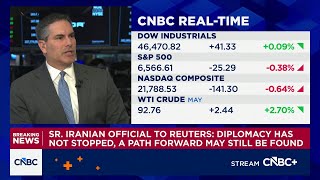
This CNBC video, published March 26, 2026, features Josh Brown, Steve Weiss discussing VLO, TSM. 2 trade ideas extracted by AI with direction and confidence scoring.
Speakers: Josh Brown, Steve Weiss · Tickers: VLO, TSM