The tariff toll: How tariff uncertainty could impact businesses
Speakers
Andrew Ross Sorkin
— Co-Anchor, Squawk Box
Steve Liesman
— Senior Economics Reporter
Joe Kernen
— Co-Anchor, Squawk Box
Summary
- The Biden administration is pivoting to "Section 122" tariffs (balance of payments authority) following the Supreme Court ruling against APA tariffs. These have a strict 150-day limit unless extended by Congress.
- Goldman Sachs estimates the effective tariff rate will fall from 10% to 9%, noting that 60-70% of tariff costs have already been passed through to consumers, raising core inflation by ~0.7%.
- A sharp debate exists regarding business impact: Liesman argues the constant regulatory changes create "debilitating uncertainty" for supply chains, while Kernen counters that markets are at all-time highs and earnings remain strong, suggesting the impact is overstated.
- The "Balance of Payments" justification for new tariffs is being challenged by economists, as foreign capital inflows (trillions in investment) contradict the definition of a balance of payments crisis.
Ideas
Steve Liesman
Senior Economics Reporter
Liesman notes the President's goal is to bring manufacturing into the US, but argues, "Only a stable tariff regime can result in that kind of investment." Domestic manufacturers (Steel, Industrials) theoretically benefit from protectionism. However, the "Second-Order Effect" of the 150-day limit is that no CEO will build a new US factory based on a tariff that might expire in 5 months. The *thesis* is bullish, but the *mechanism* (Section 122) is too temporary to trigger the CapEx boom these stocks need. WATCH. Wait for Congress to potentially lock these tariffs in for the long term before buying the "Reshoring" trade. If the 150-day period expires without renewal, foreign competition floods back in, hurting domestic pricing power.
Steve Liesman
Senior Economics Reporter
Liesman states, "It's hard to imagine the Fed doing anything but taking the Administration at their word... so the policy outlook is unlikely to change when it comes to interest rates." The Fed is looking through the tariff noise, assuming revenue replacement is neutral. Therefore, there is no immediate "Tariff Inflation Trade" that forces the Fed to hike, nor a "Growth Shock Trade" that forces them to cut. NEUTRAL. Rates markets will likely remain range-bound regarding tariff news specifically. If inflation data (CPI) surprises to the upside specifically due to the 0.7% tariff pass-through, the Fed may turn hawkish.
Steve Liesman
Senior Economics Reporter
Liesman reports that businesses involved in importing are facing "debilitating uncertainty" due to intraday changes in tariff rules, exemptions, and the new 150-day limit on Section 122 tariffs. Goldman notes 60-70% of costs are already passed to consumers. Uncertainty is the enemy of capital allocation. If retailers and importers cannot predict input costs 6 months out (due to the 150-day cliff), they will either over-hike prices (hurting demand) or freeze inventory orders (hurting revenue). The "pass-through" capacity is nearing its limit. AVOID sectors with high exposure to foreign supply chains until the Section 122 legal/legislative landscape stabilizes. If Congress quickly ratifies the tariffs, certainty returns, potentially stabilizing these stocks.
Joe Kernen
Co-Anchor, Squawk Box
Kernen explicitly pushes back on the "uncertainty" narrative, stating, "The markets hit new highs... we just went through an amazing earnings season." Price action is the ultimate truth mechanism. Despite the chaotic tariff headlines, corporate execution remains robust. The market is signaling that large-cap US companies have enough pricing power and operational flexibility to absorb or bypass tariff friction. LONG. Do not fight the tape based on macro headlines that the market has already digested. A sudden escalation where tariffs are applied strictly without exemptions could finally break the earnings trend.
Up Next

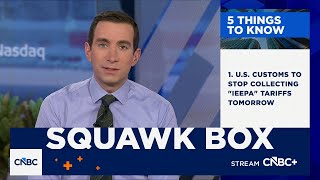

This CNBC video, published February 23, 2026, features Steve Liesman, Joe Kernen discussing NUE, XLI, STLD, TLT, IEF, XRT, TGT, NKE, QQQ, SPY. 4 trade ideas extracted by AI with direction and confidence scoring.
Speakers: Steve Liesman, Joe Kernen · Tickers: NUE, XLI, STLD, TLT, IEF, XRT, TGT, NKE, QQQ, SPY