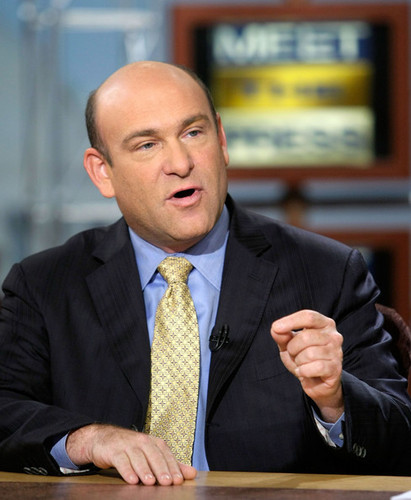
Steve Liesman 3.4 20 ideas

Senior Economics Reporter
After 1 day
N/A
6/15 min ideas
After 1 week
N/A
6/15 min ideas
After 1 month
N/A
6/15 min ideas
0 winning  /  6 losing  ·  6 positions (30d)
Net: -5.9%
By sector
ETF
13 ideas -3.7%
Stock
6 ideas -11.2%
Commodity
1 ideas -9.2%
Top tickers (by frequency)
XLI 3 ideas
0% W -5.6%
TLT 3 ideas
0% W -1.7%
NUE 2 ideas
0% W -11.2%
XLY 2 ideas
0% W -3.7%
XRT 2 ideas
Best and worst calls
While the Supreme Court struck down IEEPA tariffs, the administration reimposed new tariffs immediately. Natasha Sarin notes the effective rate only dropped from 16% to 13.7%. Liesman reports businesses face "debilitating uncertainty" and likely won't get refunds on the $175B already paid. The legal victory is pyrrhic for importers. The cost basis remains elevated, and the regulatory environment is now "mercurial" and complex, making supply chain planning impossible. This compresses margins for retailers and industrials relying on imports. Avoid sectors with high import exposure until the Section 301/232 landscape stabilizes. Companies have already priced this in (Goldman notes 60-70% of prices already passed to consumers).
XRT XLI CNBC Feb 23, 18:38
Senior Economics Reporter
Fed Governor Waller stated that the Supreme Court ruling on tariffs "may have a positive impact on spending and investment." If the legal ruling reduces tariff burdens or uncertainty, it removes a headwind for business capex (Industrials) and consumer costs (Discretionary). This creates a favorable environment for sectors reliant on investment and consumption. Long sectors tied to "spending and investment" (Consumer Discretionary and Industrials). Waller noted "considerable uncertainty" regarding how businesses will actually react and to what extent tariffs continue despite the ruling.
XLY XLI CNBC Feb 23, 14:11
Senior Economics Reporter
The government shutdown detracted approximately 1.15% from previous GDP, but forecasters are "putting it back into this quarter," with Goldman Sachs predicting 3% growth. The economic drag was temporary and artificial. The reversal of this drag creates a mechanical lift in GDP data for the current quarter, supporting the narrative of a resilient economy. Long broad US equities to capture the growth rebound. If the underlying economy (excluding government effects) slows faster than the rebound adds growth.
SPY CNBC Feb 23, 14:11
Senior Economics Reporter
Waller is "on the fence" regarding March policy. He explicitly stated a "strong February jobs report would support the pause," while "it could be appropriate to cut if February jobs are weak." The Fed views January data as potentially "noise" driven by tariffs. The February jobs report is now the binary trigger: Strong data = Higher for longer (Bearish Bonds); Weak data = Rate Cut (Bullish Bonds). Watch the February labor data; the Fed is strictly data-dependent here. January data might have been signal, not noise, leading to policy missteps.
TLT CNBC Feb 23, 14:11
Senior Economics Reporter
Liesman notes the President's goal is to bring manufacturing into the US, but argues, "Only a stable tariff regime can result in that kind of investment." Domestic manufacturers (Steel, Industrials) theoretically benefit from protectionism. However, the "Second-Order Effect" of the 150-day limit is that no CEO will build a new US factory based on a tariff that might expire in 5 months. The *thesis* is bullish, but the *mechanism* (Section 122) is too temporary to trigger the CapEx boom these stocks need. WATCH. Wait for Congress to potentially lock these tariffs in for the long term before buying the "Reshoring" trade. If the 150-day period expires without renewal, foreign competition floods back in, hurting domestic pricing power.
NUE STLD XLI CNBC Feb 23, 13:11
Senior Economics Reporter
Liesman states, "It's hard to imagine the Fed doing anything but taking the Administration at their word... so the policy outlook is unlikely to change when it comes to interest rates." The Fed is looking through the tariff noise, assuming revenue replacement is neutral. Therefore, there is no immediate "Tariff Inflation Trade" that forces the Fed to hike, nor a "Growth Shock Trade" that forces them to cut. NEUTRAL. Rates markets will likely remain range-bound regarding tariff news specifically. If inflation data (CPI) surprises to the upside specifically due to the 0.7% tariff pass-through, the Fed may turn hawkish.
TLT IEF CNBC Feb 23, 13:11
Senior Economics Reporter
Liesman reports that businesses involved in importing are facing "debilitating uncertainty" due to intraday changes in tariff rules, exemptions, and the new 150-day limit on Section 122 tariffs. Goldman notes 60-70% of costs are already passed to consumers. Uncertainty is the enemy of capital allocation. If retailers and importers cannot predict input costs 6 months out (due to the 150-day cliff), they will either over-hike prices (hurting demand) or freeze inventory orders (hurting revenue). The "pass-through" capacity is nearing its limit. AVOID sectors with high exposure to foreign supply chains until the Section 122 legal/legislative landscape stabilizes. If Congress quickly ratifies the tariffs, certainty returns, potentially stabilizing these stocks.
XRT NKE TGT CNBC Feb 23, 13:11
Senior Economics Reporter
Liesman cites seven different papers (including NY Fed, Goldman Sachs, and Yale) stating that "90% of the president's tariffs are paid by U.S. consumers and businesses." He further notes that "Manufacturing lost 83,000 jobs in the past year." If domestic companies and consumers are footing the bill for tariffs, this acts as a tax on the U.S. economy, compressing corporate margins and reducing consumer purchasing power. The specific data point on job losses indicates that the manufacturing sector is contracting rather than expanding under these conditions. AVOID sectors heavily reliant on imports or domestic manufacturing that faces rising input costs without the ability to pass them on. If importers successfully rearrange supply lines (which Liesman notes is happening slightly) or if deregulation offsets costs, the negative impact may be muted.
XLY CNBC Feb 19, 12:57
Senior Economics Reporter
Steve Liesman (Senior Economics Reporter) | 20 trade ideas tracked | XLI, TLT, NUE, XLY, XRT | YouTube | Buzzberg
