Trump Turns on Allies Over Iran War | The Asia Trade 3/18/2026
Speakers
Shery Ahn
— Anchor, Bloomberg Television
Haidi Stroud-Watts
— Anchor, Bloomberg
Garfield Reynolds
— Markets Reporter/Editor, Bloomberg
Laura Davison
— Washington Bureau Chief, Bloomberg
Fred Fleitz
— America First Policy Institute, former NSC Chief of Staff
David Chao
— Global Market Strategist, Invesco
Ed Ludlow
— Co-Host, Bloomberg Technology
Mandeep Singh
— Senior Analyst, Bloomberg Intelligence
Min Min Low
— China Correspondent, Bloomberg
Rong
— Oil Trading Reporter, Bloomberg
Finbarr
— Credit Markets Analyst, Bloomberg
Summary
- Geopolitics Dominates: The ongoing war with Iran, initiated by the US/Israel, is the central market driver, causing oil price volatility, supply chain disruptions, and re-rating of inflation/growth expectations.
- Oil Market Shock: The Strait of Hormuz is effectively closed, severing a key supply route for Asia. Refiners are scrambling for alternatives (e.g., Russian, Venezuelan crude), but logistical re-routing takes time. Oil prices spiked but have pulled back slightly on news of potential Iraqi exports via Turkey.
- Central Bank Dilemma: The Fed and other central banks (RBA, BOJ) are grappling with the inflation impulse from higher energy prices versus growth risks. The narrative control over bond markets has shifted from monetary policy to geopolitics/oil.
- AI Optimism Intact: Despite macro uncertainty, the AI investment cycle remains robust. NVIDIA's CEO forecasts $1T+ in AI chip sales (2025-2027) and is restarting H200 chip production for China under new licenses.
- China's Relative Insulation: Analyst David Chao notes China is better insulated from the oil shock due to high inventory buffers and a diversified economy focused on high-tech manufacturing and AI.
- Asian AI Play: Valuations for Asian AI-related companies (chipmakers, Tencent, Alibaba) are seen as discounted relative to US peers, with a longer growth runway. AI agent development is a next frontier but a margin drag.
- Corporate Leadership Changes: BHP and Woodside Energy appoint new CEOs (Brendan Cragg and Liz Westcott, respectively), inheriting companies with strong growth optionality in copper and LNG.
- Credit Market Opportunity: The recent sell-off in investment-grade credit has widened spreads to levels last seen in mid-2025. Some managers see this as a buying opportunity for oversold high-grade bonds.
- Stagflation Concerns in Asia: Japan and South Korea, heavily dependent on Middle East oil, face stagflation risks from a weak currency and high energy import costs, complicating central bank policy.
- War Timeline & Politics: Trump ally Fred Fleitz predicts the war could conclude in "a couple of weeks," with the US declaring victory after degrading Iran's nuclear/missile programs. Domestic US opposition to the war is noted but considered a minority view.
Ideas
David Chao stated that Asian (Chinese, Taiwanese, Korean, Japanese) AI-related stocks "still have another leg up" due to valuation discounts relative to US AI companies and expects strong earnings in coming quarters. The AI investment cycle is global. Asian companies are key suppliers (chips) and major adopters (tech platforms). Their discounted valuations offer more upside potential as the AI story continues to develop. This is an explicit call for outperformance of Asian tech/AI equities versus their US counterparts based on relative valuation. A broader collapse in AI-related spending or a significant, prolonged economic downturn in Asia.
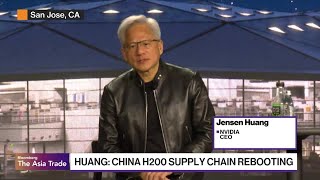
NVIDIA CEO Jensen Huang stated the company has secured licenses for many customers in China for the H200 accelerator and is restarting manufacturing. He also provided a sales outlook topping $1 trillion for AI chips from 2025-2027. The restart of China sales (a former ~25% revenue segment) provides a new growth vector. The trillion-dollar forecast underscores immense, visible demand from hyperscalers managing their AI compute supply chains. The explicit guidance on massive future sales and the resolution of a key regulatory overhang (China licenses) are strong bullish catalysts. A sharp downturn in hyperscaler capital expenditure or a renewed crackdown on technology exports to China.
The Strait of Hormuz is halted, creating a major supply shock for Asian refiners. Prices are volatile, and the market is scrambling for alternatives (Russian, Venezuelan crude). The war's duration is uncertain. Asia is the region most impacted by Middle East energy disruptions. Supply chains need time to reroute, and any further escalation or prolonged closure will keep upward pressure on prices and global inflation. The direct supply disruption and high uncertainty around conflict resolution make oil a critical asset to monitor for further price spikes or stabilization. A swift, negotiated end to the war and reopening of the Strait, or a larger-than-expected release of strategic reserves/alternative supplies.
Following a credit rout, investment-grade (IG) bond spreads have widened to ~90 bps, levels last seen in June 2025. Some money managers are moving to buy these oversold bonds. The sell-off was driven by geopolitical risk repricing, not a fundamental deterioration in corporate health. The spread widening presents an attractive entry point for high-grade credit. The analysis suggests the sell-off has created a tactical buying opportunity in high-quality corporate debt. A severe recession that actually damages corporate fundamentals and leads to sustained wider spreads or defaults.
Up Next



This Bloomberg Markets video, published March 18, 2026, features David Chao, Mandeep Singh, Rong Wei Neo, Finbarr Flynn discussing XLK, NVDA, WTI, XLF. 4 trade ideas extracted by AI with direction and confidence scoring.
Speakers: David Chao, Mandeep Singh, Rong Wei Neo, Finbarr Flynn · Tickers: XLK, NVDA, WTI, XLF