Trump Reiterates Tuesday Night Deadline For Iran | Balance of Power 04/06/2026
Speakers
Mark Esper
— Former US Secretary of Defense
Jeff Mason
— White House Correspondent
Romaine Bostick
— Anchor, Bloomberg
Joseph Lavorgna
— Former Chief Economist, National Economic Council
Becca Wasser
— Senior Fellow, CNAS
Wayne Sanders
— Senior Defense Research Analyst, Bloomberg Intelligence
Chris Hadfield
— Retired Canadian Astronaut, Fmr. Commander of the ISS
Rick Davis
— Republican Strategist, Partner at Stonecourt Capital
Jeanne Zaino
— Democratic Analyst
Summary
- President Trump has set a new deadline with Iran for a deal, threatening to target civilian infrastructure (bridges, power plants) if unmet, raising legal and escalation concerns.
- Former Defense Secretary Mark Esper assesses a strike is a probable "foregone conclusion," but doubts the stated four-hour timeline for crippling Iran, noting the country's size and the challenge of a "shock and awe" campaign.
- The primary US aims are to open the Strait of Hormuz without conditions and address Iran's nuclear program; a key risk is Iran's asymmetric response the following day.
- SMBC's Joe Lavorgna analyzes the economic impact: every $1 increase in oil prices acts as a ~$100 billion "tax hike," but the economy's strong fundamentals and recent tax cuts provide a buffer.
- Lavorgna identifies $120/barrel oil as a potential economic breaking point; current levels ($112-113) are concerning but not yet at a tipping point for consumer spending or hiring.
- Financial markets have rallied despite higher oil prices, with optimism focused on upcoming bank earnings (Goldman, J.P. Morgan, Wells Fargo).
- A notable market mover: Medicare reimbursement rates for 2027 were set at +2.5%, a positive surprise versus fears of a 0% increase, leading to a post-market rally in managed care stocks (Humana up ~13%).
- Defense analysts highlight Iran's threat from shoulder-fired, heat-seeking missiles (like the one that downed an F-15) and the risk they pose to low-flying rescue or attack aircraft.
- The Artemis II mission is scouting the lunar south pole for potential settlement, focusing on locations with water ice (for resources) and near-permanent sunlight (for solar power).
Ideas
Romaine Bostick reports that 2027 Medicare Advantage reimbursement rates were set at +2.5%, a "huge improvement" over the feared 0% increase floated earlier in the year. This led to a post-market surge (Humana +13%, others +9-10%). Higher government reimbursement rates directly improve the profitability outlook for managed care companies, which had seen shares decline 10-20% on fears of a rate cut. The announced rate alleviates the worst-case scenario. LONG due to a concrete positive catalyst (the rate announcement) that reverses a significant overhang on the sector and triggers immediate, substantial price appreciation. Underlying medical cost trends could still pressure earnings, and future rate decisions may be less favorable.
Lavorgna states that for every $1 increase in oil prices, retail gasoline rises ~2.5 cents, equating to a ~$100 billion "tax hike" on the economy when oil moves from $60 to $100. He notes $120/barrel could pose "real economic headwinds," while current levels ($112-113) are not yet at a breaking point. Sustained high oil prices directly increase energy costs for consumers and businesses, acting as a drag on disposable income and corporate margins. The speed and duration of the price move will dictate the economic damage. The energy sector is a critical watch point because oil prices are at a level that significantly impacts the economy. The direction from here—driven by geopolitical events in the next 27 hours—will determine if a major economic headwind materializes. A rapid de-escalation in the Middle East conflict could cause oil prices to fall "quite dramatically," negating the economic threat.
Up Next


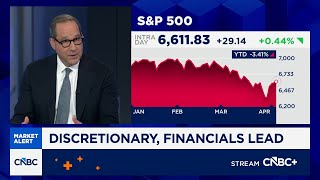

This Bloomberg Markets video, published April 06, 2026, features Romaine Bostick, Joseph Lavorgna discussing XLV, XLE. 2 trade ideas extracted by AI with direction and confidence scoring.
Speakers: Romaine Bostick, Joseph Lavorgna · Tickers: XLV, XLE