Ideas
"Retail sales have been good. Look at Costco. Look at Dick's look at Walmart." Despite fears of war and rising oil prices, underlying consumer spending remains robust. Strong economic data (Atlanta Fed GDP tracker at 2.7%) and high productivity mean these specific large-cap retailers will continue to capture consumer dollars and defend their earnings against macro volatility. LONG because domestic consumer staples and dominant retailers offer a safe haven with proven fundamental strength during geopolitical uncertainty. If oil prices remain elevated for months, it will eventually cause demand destruction at the consumer level, hurting retail margins.
"JP Morgan's trading desk is making a tactically bearish call this morning. Long energy and energy stocks and short equities." The ongoing military operation and lack of resolution in the Middle East create an asymmetric risk to global oil supplies. In a scenario where the Strait of Hormuz is closed, the broader market will sell off, but domestic energy producers will see massive margin expansion due to skyrocketing underlying commodity prices. LONG because energy equities act as the primary hedge against the specific geopolitical risks currently threatening the broader market. If a diplomatic resolution is reached quickly, the geopolitical premium in oil will evaporate, leading to a sharp pullback in energy equities.
"Bank of America in a 17% drawdown. So the credit cards Synchrony Financial down 28%, Capital One down 31%... XLF is in a drawdown almost as bad as the liberation day drawdown." Negative labor data and rising yields are pressuring consumer finance. Simultaneously, major banks are marking down assets lent to private credit firms, creating a self-fulfilling cycle of bad news, redemptions, and further markdowns. This structural weakness will drag down the broader financial sector regardless of what happens in the Middle East. SHORT because the financial sector is breaking down technically and fundamentally due to credit stress and private equity markdowns. A sudden drop in bond yields or a stronger-than-expected labor market could trigger a massive short-covering rally in beaten-down financial stocks.
"Here's another Hormuz related supply disruption this time in the materials space... CF +13%, MOS +10%, DOW +8%, LYB +7%... The Iranians are significant exporters of urea nitrogen." The Middle East is a major exporter of critical agricultural chemicals and materials. If the Strait of Hormuz is threatened, global supply is choked off. This forces buyers to pivot to domestic and alternative producers, driving immediate pricing power and revenue growth for US-based chemical and fertilizer companies. LONG as a tactical geopolitical hedge that directly benefits from Middle Eastern supply chain disruptions. This is a highly binary trade; if the Strait of Hormuz is secured and tensions de-escalate, these stocks will likely face an immediate 10% or greater drawdown.
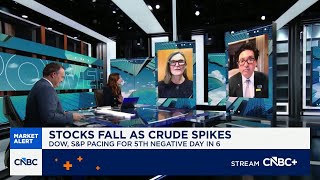
This CNBC video, published March 12, 2026,
features Jim Lebenthal, Scott Wapner, Josh Brown
discussing DKS, COST, WMT, XLE, XOM, BAC, COF, SYF, XLF, CF, MOS, LYB, DOW.
4 trade ideas extracted by AI with direction and confidence scoring.
Speakers:
Jim Lebenthal,
Scott Wapner,
Josh Brown
· Tickers:
DKS,
COST,
WMT,
XLE,
XOM,
BAC,
COF,
SYF,
XLF,
CF,
MOS,
LYB,
DOW