The SCOTUS tariff decision fallout: What it means for markets
Speakers
Scott Wapner
— Host, CNBC
Carl Quintanilla
— Anchor, CNBC
Jim Lebenthal
— Partner, Cetera Investment Management
Bryn Talkington
— Managing Partner, Requisite Capital Management
Jason Snipe
— Founder, Odyssey Capital Advisors
Joe Terranova
— Senior Managing Director, Virtus Investment Partners
Summary
- Markets are experiencing a sharp sell-off (Dow down 700+ points) driven by renewed uncertainty following the SCOTUS tariff ruling and President Trump's aggressive reaction to it.
- While the SCOTUS ruling theoretically caps tariffs at 15%, the President's threat of additional levies and refusal to process refunds has negated the expected "relief rally."
- A specific, emerging contagion risk is "Private Credit," which is cited as a major headwind dragging down traditional Financials and Private Equity names.
- Geopolitical risks (Iran) and the upcoming State of the Union address are adding to the "Wall of Worry" alongside Nvidia earnings.
Ideas
"Continuing concerns about private credit. I think that's what's hanging on to the financials in particular." The market is pricing in second-order effects where stress in the opaque Private Credit market spills over into the balance sheets or sentiment regarding major traditional banks. If Private Credit is "broken," the liquidity crunch affects the broader financial ecosystem. Financials are a sell/avoid until the Private Credit stress resolves. Better-than-expected economic data or a "soft landing" confirmation could alleviate credit concerns quickly.
"I felt like the thesis around my trade did not play out. And so I just, you know, sold it and moved on." The speaker originally bought these consumer names expecting the SCOTUS ruling to remove tariff headwinds. However, the President's hostile reaction and the lack of clarity on refunds mean the "tariff headwinds" remain a significant risk to margins. When the catalyst for a trade fails (even if the legal ruling was favorable), the trade must be closed. The speaker has exited these positions; the sector remains vulnerable to tariff volatility. A sudden clarification from the administration allowing refunds or lowering rhetoric could spark a relief rally the speaker misses.
Jason Snipe
Founder, Odyssey Capital Advisors
"Just uncertainty about will there be tariff refunds? What is that story going to look like? How does that affect margins...?" Companies that rely on imports (discretionary goods) face unquantifiable margin compression risks. The market hates uncertainty more than bad news; until the tariff implementation (10% vs 15% vs refunds) is clear, valuations will compress. Avoid sectors with high import exposure. Companies may successfully pass costs to consumers without hurting demand, preserving margins.
Carl Quintanilla
Anchor, CNBC
"Plenty of demand right now for Treasuries." With equities selling off (-1% across the board) and geopolitical/tariff uncertainty rising, capital is fleeing risk assets and moving into the safety of sovereign debt, driving yields down and prices up. A defensive rotation trade is active. A hot inflation print or hawkish Fed commentary could hurt bond prices despite the safety bid.
Up Next


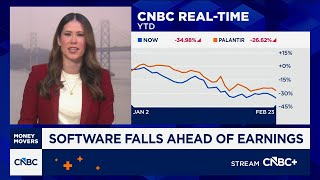


This CNBC video, published February 23, 2026, features Jim Lebenthal, Bryn Talkington, Jason Snipe, Carl Quintanilla discussing C, GS, JPM, XLF, NKE, ONON, XLY, TLT. 4 trade ideas extracted by AI with direction and confidence scoring.
Speakers: Jim Lebenthal, Bryn Talkington, Jason Snipe, Carl Quintanilla · Tickers: C, GS, JPM, XLF, NKE, ONON, XLY, TLT