U.S.-China trade talks: Here's what you need to know
Speakers
Brian Sullivan
— Anchor, CNBC (Last Call / Power Lunch)
Scott Bessent
— Treasury Secretary
David
— Anchor
Sara
— Anchor
Summary
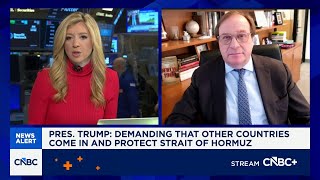
- U.S. Treasury Secretary Scott Bessent dismissed media reports suggesting the upcoming Trump-Xi trade meeting is being delayed due to China's refusal to police the Strait of Hormuz, clarifying that any delay is strictly logistical due to the President coordinating the ongoing war effort.
- Bessent revealed a massive structural global oil deficit of 10 to 14 million barrels per day, which exists even before factoring in shipping blockades in the Strait of Hormuz.
- To bridge this energy gap, the market is currently relying on a combination of Russian oil (9-12 days of supply), 140 million barrels of Iranian oil floating on the water, Saudi reserves, and a record-breaking 400-million-barrel global SPR release.
Ideas
"There's a false narrative out there that if the meetings are delayed, it wouldn't be delayed because the president's demanded that China police the Straits of Hormuz... That's completely false." Markets often sell off on rumors of deteriorating U.S.-China relations. By confirming that any delay in the Trump-Xi meeting is purely logistical rather than retaliatory, Bessent signals that the underlying trade negotiations remain intact. This prevents a worst-case scenario for Chinese equities, which rely heavily on stable export tariffs and diplomatic predictability. WATCH Chinese large-caps for a relief rally as the market prices out the false narrative of a new diplomatic rift over the Middle East conflict. The logistical delay could still drag out indefinitely, and broader macroeconomic weakness in China's domestic economy could weigh on these equities regardless of U.S. trade relations.
"If the meeting for some reason is rescheduled, it would be rescheduled because of logistics. The president wants to remain in DC to coordinate the war effort." The explicit confirmation from the Treasury Secretary of an active, high-level "war effort" involving the U.S. and Iran signals sustained, if not increasing, defense expenditures. Defense contractors that supply munitions, aerospace technology, and naval support will see increased order backlogs and expedited government funding to support prolonged military engagements. LONG defense primes and sector ETFs as geopolitical conflict transitions into active, coordinated U.S. military operations. A sudden diplomatic resolution, ceasefire, or regime change could cause a rapid unwinding of the geopolitical risk premium currently priced into defense stocks.
"It looks like the deficit is about 10 or 14 [million barrels], and that's before any of the ships are coming out of the straits." A daily supply deficit of 10-14 million barrels is historically massive. While the government is using emergency levers (a 400M barrel SPR release) and floating storage to temporarily buffer the shock, these are finite resources. Once these emergency reserves are depleted, the underlying structural deficit—compounded by active war in the Middle East—will inevitably force crude prices significantly higher. LONG oil as the fundamental supply/demand imbalance heavily favors higher prices, which cannot be permanently suppressed by one-off reserve releases. The massive 400M barrel SPR release, combined with Saudi spare capacity and floating Iranian storage, could suppress prices longer than anticipated, leading to near-term sideways price action.