Ideas
Block (SQ) announced a 50% workforce reduction, citing AI efficiency, causing the stock to surge ~20%. While Dolev believes this is partly "trimming post-pandemic bloat," the market is rewarding the narrative of "AI replacing labor." This creates momentum. Jack Dorsey is historically early to trends; this signals a structural margin improvement. LONG SQ as a beneficiary of aggressive cost-cutting and AI narrative adoption. Cutting too deep could damage product innovation; "human touch" is still needed in payments.
Auth notes "asset-light" software companies (guys in a garage coding) are losing their premium because AI is now their competitor. Subramanian notes Tech is becoming "asset-heavy" (high capex) and leverage is increasing, warranting P/E compression. The era of infinite margin expansion for SaaS is over. AI agents will replace seat-based software pricing. Investors should rotate from high-multiple software into "real economy" assets. AVOID / SHORT generic SaaS and high-P/E software names. AI integration actually accelerates software adoption and retention.
Nvidia sold off recently despite beating earnings. Auth argues the debate is whether AI is a "one-off" build or a 10-year cycle. Nvidia is the *only* player that cannot be cannibalized by AI software because it provides the infrastructure. If the AI build-out continues (as indicated by Dell/CoreWeave capex), Nvidia remains the primary beneficiary. LONG NVDA on pullbacks; it is the "screaming buy" if the AI thesis holds. Hyperscalers (AMZN/GOOG/MSFT) successfully shift to internal custom chips.
International markets (Europe, Japan, Korea) are heavy on "Asset-Heavy" businesses (manufacturing, industrials) and trade at lower valuations (18x vs US 22x). As the US market compresses due to the "AI disruption" of software, capital will rotate to undervalued, tangible-asset businesses found in international markets. LONG Non-US Developed Markets as a valuation hedge against US Tech. Global recession hurts export-oriented economies like Germany and Korea.
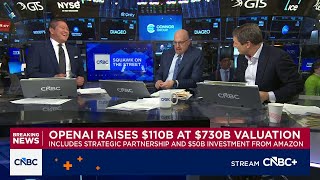
Auth notes Amazon has a profitable base business (retail/logistics) to fall back on if AI is a bubble. Singh reports Amazon is investing $50B in OpenAI, reducing OpenAI's reliance on Microsoft. Amazon is the "pick and shovel" play that isn't purely speculative. The OpenAI deal validates AWS and Amazon's custom silicon (Trainium/Inferentia) as viable alternatives to Nvidia/Microsoft. LONG AMZN as a diversified AI winner with defensive retail cash flows. AI capex spend (up to $200B mentioned) drags on free cash flow without immediate ROI.
Netflix dropped out of the bidding war for Warner Bros Discovery. Investors are cheering "capital discipline." By not overpaying for legacy assets, Netflix preserves its balance sheet and dominance. LONG NFLX. Subscriber growth saturation.
With Netflix out, Paramount (PARA) is the likely winner of the consolidation/acquisition play (Skydance deal mentioned). The deal premium is now more certain with a competing bidder removing the "overpayment" risk for the acquirer, but solidifying the exit for PARA shareholders. LONG PARA (Merger Arbitrage/Event Driven). Regulatory hurdles (antitrust) or deal financing failure.
Competitors in the payments space (Toast, Global Payments, Fiserv) rely heavily on "human touch" for relationship management with merchants. If the market demands "Block-like" cuts from these competitors to boost margins, they may be forced to cut staff that are actually revenue-critical (customer service/sales), unlike Block's developer-heavy cuts. WATCH. Be careful of a knee-jerk "efficiency" trade in high-touch fintechs where cuts could degrade service quality. They successfully implement AI without losing clients.
Despite narratives of "de-dollarization," foreign holdings of Treasuries are rising, and the dollar's share of global payments is stable. Rivals (Euro, Yuan) have structural flaws (fragmentation, capital controls). In a world of geopolitical turmoil, the "flight to safety" flows into the deepest, most liquid market: the USD. LONG USD. U.S. fiscal trajectory (debt spiral) eventually erodes trust.
10-Year yields are breaking below 4% despite hot PPI data. Credit spreads are widening. The bond market is signaling a "growth scare" or "flight to safety." Guha argues AI is disinflationary in the short term (wage suppression). Al-Hussainy notes a bid for liquidity due to private market jitters. LONG US TREASURIES (Duration) as a hedge against equity volatility and disinflation. Inflation re-accelerates significantly, forcing the Fed to hike or hold longer.
This Bloomberg Markets video, published February 27, 2026,
features Dan Dolev, Stephen Auth, Jonathan Ferro, Eswar Prasad, Krishna Guha
discussing XYZ, IGV, NVDA, EWG, EWY, EWJ, AMZN, NFLX, PSKY, GPN, FI, TOST, USD, TLT.
10 trade ideas extracted by AI with direction and confidence scoring.
Speakers:
Dan Dolev,
Stephen Auth,
Jonathan Ferro,
Eswar Prasad,
Krishna Guha
· Tickers:
XYZ,
IGV,
NVDA,
EWG,
EWY,
EWJ,
AMZN,
NFLX,
PSKY,
GPN,
FI,
TOST,
USD,
TLT