Ideas
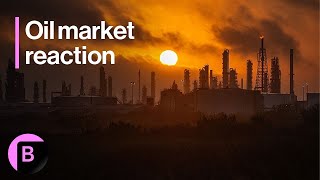
1. The Fact: Fesharaki states, "Yesterday I predicted... prices would be $77... there is no reason to expect a big jump." He explicitly claims, "When the crisis is over? Prices go to 60 bucks." 2. The Bridge: The market is pricing in a blockade of the Strait of Hormuz, but Fesharaki argues Iran cannot sustain a closure ("They can close for a few days, maybe a week... but you can't close it"). If the Strait remains open and Strategic Petroleum Reserves (SPR) are released, the risk premium evaporates, sending crude down to fundamental supply/demand levels ($60). 3. The Verdict: SHORT oil futures or ETFs on war spikes. Ziad Daoud notes a "Strait of Hormuz shut down" scenario could send oil to $108.
1. The Fact: "Thousands of flights a day being cancelled in and out of some of these key transit hubs, particularly Dubai... impacts Persian Gulf carriers but also foreign airlines." 2. The Bridge: The closure of airspace and risk of missile strikes forces airlines to reroute (increasing fuel burn/costs) or cancel flights entirely (revenue loss). This specifically hurts carriers dependent on Middle East hubs or Asian-European transit routes. 3. The Verdict: AVOID airlines with heavy international exposure. A quick ceasefire could lead to a sharp relief rally in travel stocks.
1. The Fact: Al-Hammoury states, "Tech is still on my watch list... Oracle, for example, we were down over about 40 to 45% from the peak... Microsoft, Nvidia... names would be nice to have at least on my long term portfolio, especially after that dip." 2. The Bridge: Despite geopolitical panic, AI CapEx spending remains robust (~$450B mentioned). The strategist views the war-induced sell-off as a liquidity shock rather than a fundamental break in the AI thesis. The "dip" provides an entry point for structural winners. 3. The Verdict: LONG high-quality tech/AI names. If oil hits $100+, inflation expectations rise, forcing the Fed to hike rates, which crushes long-duration tech assets.
1. The Fact: "India is a net oil importer... impact on oil is likely to have ramifications on the economy... trade deficit... inflation." Reliance (RIL) is explicitly mentioned as "down by one and a half percent." 2. The Bridge: India imports 5 million barrels of oil per day. A sustained spike in oil widens the trade deficit and weakens the Rupee (INR), acting as a tax on the Indian economy. Additionally, 9 million Indian expats in the Gulf face instability, threatening remittance flows. 3. The Verdict: SHORT Indian equities and the Rupee proxy. Oil prices collapsing back to $60 (Fesharaki's thesis) would reverse this dynamic immediately.
1. The Fact: "Gold really shining through on its haven appeal... Dollar very much is definitely taken most of the bids." 2. The Bridge: In the "fog of war," liquidity dominates ideology. Investors are fleeing risk assets (Asian equities) for traditional safe havens. If gold rallies *while* real yields rise (which is happening), it indicates structural risk repricing, not just temporary fear. 3. The Verdict: LONG Safe Havens. De-escalation or a "sell the news" event if the conflict concludes quickly.
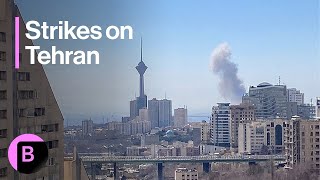
This Bloomberg Markets video, published March 02, 2026,
features Fereidun Fesharaki, Danny Lee, Nour Eldeen Al-Hammoury, Shruti Shrivastava, Chiranjeevi Chakraborty
discussing BRENT, INDIGO, JETS, UAL, AAL, ORCL, NVDA, MSFT, INDA, RIL, GLD, USD.
5 trade ideas extracted by AI with direction and confidence scoring.
Speakers:
Fereidun Fesharaki,
Danny Lee,
Nour Eldeen Al-Hammoury,
Shruti Shrivastava,
Chiranjeevi Chakraborty
· Tickers:
BRENT,
INDIGO,
JETS,
UAL,
AAL,
ORCL,
NVDA,
MSFT,
INDA,
RIL,
GLD,
USD