Bloomberg Surveillance 3/17/2026
Speakers
Jonathan Ferro
— Anchor, Bloomberg Television
Lisa Abramowicz
— Anchor, Bloomberg Television and Radio
Annmarie Hordern
— Reporter, Bloomberg
Julian Emanuel
— Evercore ISI
Joumanna Bercetche
— Anchor, Bloomberg
Victoria Coates
— VP, Heritage Foundation
Tyler Kendall
— Multimedia Editor, Bloomberg
Tony Wang
— Portfolio Manager, T. Rowe Price
Alex
— Global Head of Cross-Asset Strategy, Barclays (full name not provided in transcript)
Bob McNally
— President and Founder, Rapidan Energy Group
Liz Ann Sonders
— Chief Investment Strategist, Charles Schwab
Gill Gloria
— Analyst, Davidson (full name and title not fully provided)
Greg Daco
— Chief Economist, EY-Parthenon
Lisa Hornby
— Head of Global Fixed Income, Schroders
Summary
- Geopolitical tensions and direct strikes on energy infrastructure in the Persian Gulf (UAE's Shah gas field, Fujairah port) are keeping Brent crude above $100 and WTI near $97, with diesel prices exceeding $5/gallon in the U.S.
- The conflict introduces a two-sided stagflationary risk for central banks: upside inflation pressure from energy costs and downside risks to growth and employment. The Fed is widely expected to hold rates but may revise up inflation forecasts.
- Market resilience is noted: despite oil more than doubling from its December low, the S&P 500 is only ~5% off highs. This is attributed to robust consumer demand and corporate earnings resilience.
- Julian Emanuel (Evercore) projects 11.1% earnings growth for 2026, noting that in years with double-digit growth, the market has been up 10 out of 11 times since 1996.
- The airline sector (Delta, American) is showing surprising strength, raising Q1 revenue guidance on strong demand, suggesting the consumer and corporate travel remain resilient despite higher fuel costs.
- NVIDIA's CEO Jensen Huang forecast at least $1 trillion in cumulative sales through 2027, extending visibility but leaving the market skeptical about sustainability, with the stock trading at a market multiple.
- A key uncertainty is the U.S. administration's ability to form a coalition to secure the Strait of Hormuz, with European allies showing reluctance or lack of capability, highlighting a potential NATO weakness.
- Credit markets remain relatively well-behaved with issuance pipelines open (e.g., large JP Morgan-led LBO debt deal), though concerns persist about private credit, with Morgan Stanley warning of potential 8% default rates in software due to AI disruption.
- Positioning data shows a significant but not extreme de-risking: systematic funds and hedge funds have reduced exposure, cash levels in the BofA Fund Manager Survey saw the biggest monthly jump since the pandemic, but retail hasn't capitulated.
- There is ongoing uncertainty regarding Federal Reserve leadership, with Chair Powell's term ending soon and political complications potentially extending his tenure.
Ideas
The speaker states, "the fact that you will get double digit earnings growth this year speaks to the fact that markets can move higher." He projects 11.1% earnings growth for 2026 and notes that in the 11 years since 1996 with double-digit growth, the market was up 10 times. Despite geopolitical shocks and oil price spikes, the underlying resilience of the U.S. economy and corporate earnings power provides fundamental support for equity prices. The earnings growth trajectory is constructive for the market. The recent pullback is seen as a reflection of resilience, not a fundamental breakdown. The oil price shock escalates to a point (e.g., sustained above a consumer breaking point) that it precipitates an economic slowdown severe enough to crush earnings expectations.
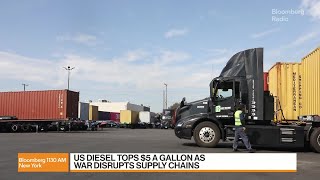
The speaker notes that logistics companies have seen more share price volatility than many other areas, partly due to speculation or the potential for rising fuel prices. Diesel above $5/gallon is flagged as an issue with a bigger effect on the economy. Higher diesel and jet fuel prices directly increase operational costs for freight, logistics, and airlines, potentially dampening economic activity and corporate profitability in the sector. The sector is under clear pressure from input costs linked to the geopolitical shock, making it an area to watch for signs of earnings degradation or broader economic contagion. Oil prices recede quickly, or companies demonstrate an exceptional ability to pass on costs and maintain demand (as seen with airlines in the transcript).
The speaker states Iran's strategy is to inflict an oil price increase as its "only card," and they will not let enough oil out to put prices down, aiming to keep upward pressure on crude and product prices. Continued attacks on logistics and energy infrastructure across the Gulf, coupled with Iran's controlled release of tankers, are designed to sustain a price shock. The market's load-bearing assumption—that the U.S. would not allow a prolonged Strait of Hormuz disruption—is collapsing. The situation is dynamic and not yet resolved, creating a high-stakes environment where prices could move significantly higher (to $150-160) if the disruption worsens, or lower if resolved. It demands close monitoring. A diplomatic off-ramp is reached, China and other major importers pressure Iran, or demand destruction kicks in at a lower price point than anticipated.
Up Next



This Bloomberg Markets video, published March 17, 2026, features Julian Emanuel, Bob McNally discussing SPY, JETS, WTI. 3 trade ideas extracted by AI with direction and confidence scoring.
Speakers: Julian Emanuel, Bob McNally · Tickers: SPY, JETS, WTI