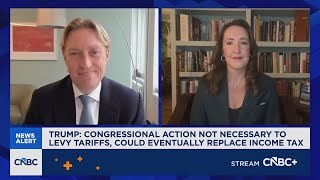
Rep. Schneider: We need to focus on the things that are making life hard for American families
Speakers
Brad Schneider
— Congressman (D-IL), Chair of New Democrat Coalition
Summary
- Congressman Schneider identifies the expiration of ACA premium tax subsidies as a critical financial cliff, noting families could see insurance costs rise by $1,500/month ($18,000 pre-tax/year).
- He emphasizes a legislative focus on "affordability," specifically targeting the cost of groceries, housing, and healthcare/medicines.
- Schneider defends the economic contribution of immigrants in "backbreaking jobs," contrasting this with the administration's rhetoric, highlighting a key labor supply friction point for the economy.
Ideas
Brad Schneider
Congressman (D-IL), Chair of New Democrat Coalition
Schneider states a goal to "work on reducing the cost of medicines." This is standard Democratic policy rhetoric signaling continued legislative pressure on pharmaceutical pricing power. While the IRA (Inflation Reduction Act) already initiated this, continued focus suggests potential expansion of drug price negotiation lists. WATCH. Regulatory headwinds remain persistent for pure-play pharma. Gridlock in Congress preventing new legislation (bullish for Pharma).
Brad Schneider
Congressman (D-IL), Chair of New Democrat Coalition
Schneider argues that immigrants "work in jobs that other people don't want to take on," specifically citing "harder, backbreaking jobs." This highlights the labor supply dependency of sectors like Agriculture, Construction, and Hospitality. The conflict between Schneider's view (maintain labor supply) and the Administration's view (restrict/deport) creates volatility. If labor supply tightens (Trump wins this argument), wages rise and margins compress for labor-heavy firms, accelerating the need for automation (ROBO/BOTZ). WATCH. Monitor immigration policy enforcement; if strict, Short Labor-Intensive Sectors / Long Automation. Comprehensive immigration reform (which Schneider mentions as a goal) could stabilize labor supply, reducing the immediate urgency for automation.
Brad Schneider
Congressman (D-IL), Chair of New Democrat Coalition
Schneider explicitly highlights the "extension of the premium tax subsidies" as a priority, warning that without it, "millions of families are seeing their insurance increase by $1,500 a month." These subsidies (enhanced ACA tax credits) are direct revenue drivers for Managed Care Organizations (MCOs) focused on the exchange market. Schneider's push indicates that Democrats will make extending these credits a non-negotiable condition in budget talks. If extended, enrollment numbers for Centene, Molina, and others remain robust; if they lapse, churn increases and revenue drops. LONG. The political pressure to avoid an $18k/year cost spike for voters is high, favoring an eventual extension which benefits ACA-heavy insurers. Republican opposition to "pandemic-era" subsidy extensions could lead to a lapse, crushing margins for exchange-focused insurers.
Brad Schneider
Congressman (D-IL), Chair of New Democrat Coalition
Schneider lists "the cost of housing" alongside groceries as the primary hardships for American families that Congress must address. When politicians focus on housing affordability, policy responses typically involve demand-side subsidies (down payment assistance) or supply-side tax credits for entry-level construction. This political attention favors large-scale homebuilders capable of delivering high volumes of lower-cost inventory. WATCH. Look for specific bipartisan bills incentivizing entry-level supply. High interest rates (macro factor) outweighing legislative incentives; failure to pass bipartisan housing legislation.