US Aims to Curb Soaring Oil Prices | Balance of Power: Editor Edition 3/18/2026
Speakers
Joe Mathieu
— Host, Bloomberg Radio
Kailey Leinz
— Bloomberg Reporter
Rep. Haley Stevens
— Democratic Congresswoman, Michigan
Rick Davis
— Republican Strategist, Partner at Stonecourt Capital
Jeanne Sheehan Zaino
— Visiting Democracy Fellow, Harvard Kennedy School Ash Center
Clayton Siegel
— Senior Fellow, CSIS (Energy Security)
Summary
- Geopolitical conflict with Iran has closed the Strait of Hormuz, paralyzing a key chokepoint for ~20% of global energy trade.
- Oil prices are sharply higher: WTI nearing $100/bbl, Brent at ~$109/bbl. Physical market disruptions are severe, with almost no oil/gas cargoes moving from the Gulf for weeks.
- The conflict is introducing stagflationary risks: higher energy prices cascade into broader inflation (e.g., diesel, fertilizer, food) while threatening GDP growth via paralyzed shipping.
- Political consensus is absent: Rep. Stevens opposes the war, citing costs (~$8B/day) and pain at the pump. A split is evident within the MAGA base over the intervention's justification.
- Policy responses (SPR release, Jones Act waiver) are seen as insufficient to materially lower prices; the only real fix is a reopening of the Strait of Hormuz.
- The Federal Reserve faces a dilemma: monetary policy cannot fix a supply shock, and higher energy prices threaten a resurgence of broader inflation the Fed has worked to tame.
- Risk of escalation remains high: Iran has threatened retaliation against energy infrastructure in neighboring countries, which could cause longer-term supply damage.
- European and Asian economies are more exposed to Middle East energy disruptions than the U.S., particularly for diesel and LNG, amplifying global economic risk.
Ideas
The Strait of Hormuz is "paralyzed," with almost no oil and gas cargoes moving from the Gulf for weeks, representing a major disruption to ~20% of global supply. The market is pricing the duration and volume of this disruption. Further escalation, such as Iran targeting regional energy infrastructure, could prolong the outage and push prices significantly higher (e.g., $5/gallon gasoline). The situation is a major bullish supply shock with high uncertainty. The direction is WATCH due to the binary, escalating nature of the geopolitical risk and its direct, disproportionate impact on the oil complex. The Strait reopens quickly, or a diplomatic solution is reached, swiftly alleviating the supply disruption.
Diesel prices are soaring (cited as nearing $200/bbl in some Asian markets) and diesel is "the fuel of the 18-wheeler" that moves all goods. Higher diesel costs are a direct input cost for the entire transportation and logistics sector. These costs will be passed through, increasing prices for all shipped goods and squeezing margins for carriers. The sector faces a significant, near-term cost-pressured environment with limited ability to avoid the macro shock. The direction is AVOID as it is a direct conduit for stagflationary energy price transmission. A rapid de-escalation in the Middle East leads to a swift normalization of diesel and crude prices.
Up Next


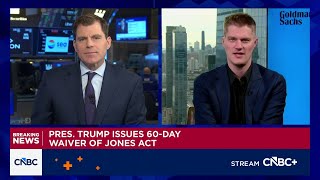

This Bloomberg Markets video, published March 18, 2026, features Clayton Siegel discussing WTI, JETS. 2 trade ideas extracted by AI with direction and confidence scoring.
Speakers: Clayton Siegel · Tickers: WTI, JETS