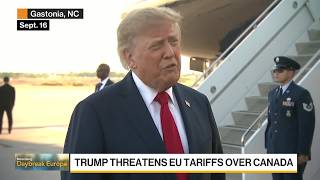
Trump Calls for Lower US Rates After Fed's Warsh Delivers Hike

Watch on YouTube ↗  |  September 17, 2026 at 06:36  |  46:05  |  Bloomberg Markets
Speakers
Ven Ram — Markets Live Reporter/Strategist, Bloomberg
James Bullard — Former President, Federal Reserve Bank of St. Louis; Dean, Purdue University's Mitch Daniels School of Business
Stephen Carroll — Co-Host, Bloomberg Daybreak Europe
Tom Mackenzie — Anchor, Bloomberg
Charlie Wells — Bloomberg Reporter

Summary

The Fed raised rates and signaled another hike as inflation remains too high, with Chair Kevin Warsh emphasizing inflation risks. Markets stabilized after the decision, while the Bank of England was expected to hold with a hawkish tilt. President Trump threatened new EU tariffs over Canada's potential associate membership, oil fell on Saudi pipeline restoration news, and AI safety and Sweden's election were also in focus.

  • Fed raised rates and signaled another hike as inflation remains too high.
  • Markets found relief in the Fed's hawkish stance; bond yields retreated after an initial rise.
  • Bank of England was expected to hold with a hawkish tilt as energy prices pressure inflation.
  • Trump threatened tariffs or halting trade with the EU over Canada associate membership.
  • Saudi pipeline restoration pushed oil lower; the Strait of Hormuz remained closed.
  • King Charles met AI leaders on safety; OpenAI published a misalignment reporting framework.
  • Sweden's center-left bloc was projected to win narrowly, leaving coalition and euro debate uncertain.
  • James Bullard saw one more Fed hike, possibly in December, and rates could rise on fiscal deficits.
Ideas
Ven Ram Markets Live Reporter/Strategist, Bloomberg 6:42
Rates stickier; long-end yields higher.
Ven Ram argues the Fed's higher neutral-rate estimate is an admission that inflation and interest rates will be stickier, which has already pushed the long end of the curve higher. He also thinks the Fed benchmark rate will get to 4.10% sooner rather than later, and if crude prices stay elevated the Fed may be compelled to raise rates even further.
Pipeline restart may ease oil disruption.
Abeer says Saudi Arabia's East-West pipeline could restore half its capacity within days and full capacity within weeks, which would be positive for energy flows and Europe because of its physical proximity. However, the Strait of Hormuz remains shut and Iran wants to assert dominance over the waterway, keeping the oil-supply outlook uncertain.
James Bullard Former President, Federal Reserve Bank of St. Louis; Dean, Purdue University's Mitch Daniels School of Business 40:10
Rates can rise on fiscal deficits.
James Bullard expects one more Fed rate increase before the end of the year, most likely in December, and says rates could go somewhat higher from here. He attributes upward pressure on rates to a strongly performing economy and large U.S. fiscal deficits that lack a credible containment plan.
Up Next

This Bloomberg Markets video, published September 17, 2026, features Ven Ram, Abeer, James Bullard discussing US long-end Treasuries, WTI, IEF. 3 trade ideas extracted by AI with direction and confidence scoring.

Speakers: Ven Ram, Abeer, James Bullard  · Tickers: US long-end Treasuries, WTI, IEF