Ideas
Avoid long-term U.S. Treasuries.
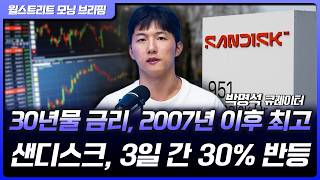
Long-end Treasury yields are rising because bond investors face too much uncertainty and are demanding higher returns, while 30-year paper has weak demand and short-dated paper has better demand. Therefore long-term U.S. Treasuries are unattractive, even though the 30-year yield hitting its highest since 2007 is not itself a reason to panic.
SanDisk buyback supports stock.
SanDisk's shareholder return is large and was underappreciated when it reported earnings: it announced a $4.5B buyback this quarter plus an additional $15B buyback, and its roughly 50% free-cash-flow margin implies about $20B in buybacks, equivalent to about 9-10% of market cap. The investor day added no new information but reframed the same story in long-term terms.
TSMC and ASML strong through 2030.
TSMC and ASML are world leaders in semiconductor manufacturing and equipment, and they said AI-related demand would remain very strong through 2030. The market initially ignored that message, but the same long-term AI demand logic supports these leaders.
Watch Walmart guidance on consumer.
One month of weak U.S. consumption data is not enough to judge a downturn. This week's U.S. retail earnings, especially Walmart's guidance, will be the key test for whether consumer spending is actually rolling over; if consumption is weak, the market debate becomes whether that forces rate cuts or simply confirms deterioration.
US refining stocks are strong.
Crude oil around $84 is not historically constraining because the U.S. economy and equity market have grown much larger over the past 20 years. However, refining margins are unusually high due to insufficient refining capacity, which is why U.S. refining-related stocks are performing well.
Hardware and semiconductors likely lead Nasdaq.
If the Nasdaq makes a new high before the September FOMC, leadership is likely to compress into previously beaten-down hardware and semiconductor names rather than broad big-tech participation, because hardware had already corrected and can grind the index higher while big tech consolidates.
Big tech likely goes sideways.
Big tech has already rebounded strongly from its lows, with Microsoft moving from about 340 to near 500. The speaker expects big tech to consolidate or just hold up rather than lead the next Nasdaq leg higher, because its large market cap makes a new high difficult if big tech falls.
US biotech could lead Nasdaq.
Biotech is making new highs and remains genuinely strong in the U.S.; if the Nasdaq advance continues into the FOMC, biotech is one of the narrow leadership pockets that could keep working while big tech pauses.
Nvidia earnings likely not bad.
Nvidia's actual earnings are unlikely to be bad: there has been no negative preannouncement, Jensen Huang has been making positive public comments about AI, and the company would face serious legal risk if results contradicted that. If forced to lean one way, the speaker would bet on a not-bad report, though next-quarter guidance is the real unknown.
S&P 500 has about five percent upside.
The speaker sees the S&P 500 high around 8,000-8,200 versus roughly 7,800 now, leaving about 5% upside into the September FOMC. He would trade the remaining upside via buy-the-dip, but investors who are 100% equities should use the strength to trim to about 70% stocks and 30% cash as risk management.
Prefer short-term Treasuries over gold.
Citing Buffett's framework, the speaker says investors considering gold should instead prefer U.S. short-term Treasuries because they pay interest while gold has none. Gold only makes sense if you expect a 1970s-style stagflation or assume the U.S. cannot service its debt, which is unrealistic.
Prefer short-term Treasuries over gold.
Citing Buffett's framework, the speaker says investors considering gold should instead prefer U.S. short-term Treasuries because they pay interest while gold has none. Gold only makes sense if you expect a 1970s-style stagflation or assume the U.S. cannot service its debt, which is unrealistic.
Korea should follow US risk.
Korean equities should not be judged by their own short-term swings: the U.S. is about 65% of world market cap versus Korea's 2%, and as U.S. indexes approach highs, Korean investors should also manage risk and use U.S. breadth rather than Korean price action. On days when memory stocks surge, Korea can enjoy the rally but should not extrapolate it into a broad bull case.
This 3PRO TV (삼프로TV) video, published August 17, 2026,
features Han Sang-hee
discussing U.S. 30-Year Treasury, SNDK, ASML, TSM, WMT, CRAK, SMH, US Big Tech, XBI, NVDA, SPY, U.S. short-term Treasuries, GLD, Korean equities.
13 trade ideas extracted by AI with direction and confidence scoring.
Speakers:
Han Sang-hee
· Tickers:
U.S. 30-Year Treasury,
SNDK,
ASML,
TSM,
WMT,
CRAK,
SMH,
US Big Tech,
XBI,
NVDA,
SPY,
U.S. short-term Treasuries,
GLD,
Korean equities