Ideas
Megabanks strong despite rich tangible-book valuations.
Although Aaron says JPMorgan is not cheap and trades at rich multiples to tangible book, he is willing to give pockets of weakness a pass because the longer-term story for JPMorgan and other U.S. megabanks is strong. He argues they have reach not just to the U.S. consumer but also to emerging markets and global growth areas, leaving them reasonably well positioned.
Industrial metals super cycle restarts on fragmentation.
Aaron says the metals story is not just gold; aluminum and platinum are already up mid-single to double digits. He views this as a growth story driven by fragmentation rather than globalization: for national security and other reasons, the U.S. and its allies need metals to build missiles and to build out AI at home, restarting a commodity super cycle.
Gold bid continues on central bank buying.
Aaron says the metals story and the gold story have legs. He sees gold as another currency, just not a fiat currency, and points to dramatic net gold purchases by central banks outside the U.S., especially Russia, China, and others. Gold has risen from 6% to 22% of central bank foreign reserves, and he expects that bid to continue as China trades more with Latin America and emerging markets and converts those currencies into gold reserves.
Big banks positive on loan growth, buybacks.
Christopher says the outlook is very positive for big banks with real GDP growth around 2%, loan growth picking up, banks overcapitalized and buying back stock, regulatory relief, and strong industry profitability. He also highlights strong credit details at Bank of America, with commercial and overall losses down, creating flexibility on credit costs; if the economy moves forward, these companies are poised to make a lot of money.
Midcap banks offer catch-up valuation trade.
Christopher says large banks have already had a huge run, but mid-size and smaller banks are still in a catch-up mode and can see better valuation pickup. He argues they are more insulated from White House policy headlines and that the White House likes community banks, helping small-cap banks. His preferred ways to play the catch-up trade are First Citizens, First Horizon, Pinnacle, and Ameris Bank.
High-quality bonds attractive versus full equities.
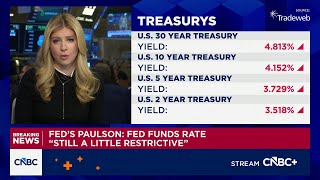
Andrew says the U.S. bond market can offer 6%-plus yields, and a high-quality bond fund can pay around 7%. That looks very good to him when U.S. equity valuations look full and there is domestic and international policy uncertainty. He sees inflation coming down and growth resilient, with a 3% terminal rate and a 4% 10-year Treasury yield looking reasonable.
Front-end rates attractive; curve steepener works.
Andrew says it is hard to see Fed hikes and the risks are toward lower terminal rates. He recommends positioning for that on the yield curve by being longer the front end, especially the five-year part of the curve, and considering a curve steepener. He says long-term interest rates are becoming more attractive and PIMCO is positioning for lower rates across portfolios.
Front-end rates attractive; curve steepener works.
Andrew says it is hard to see Fed hikes and the risks are toward lower terminal rates. He recommends positioning for that on the yield curve by being longer the front end, especially the five-year part of the curve, and considering a curve steepener. He says long-term interest rates are becoming more attractive and PIMCO is positioning for lower rates across portfolios.
Japanese JGB belly offers interesting volatility.
Andrew says the Japanese government bond market has been an anchor to global bond yields, but the prospect of a snap election and more fiscal stimulus is creating spillover and potential volatility. He finds the belly/curve of the JGB market very interesting and expects Japan to provide good opportunities and spillovers into global curve shape this year.
Gold and silver debasement trade continues.
Annmarie says gold and silver are at record highs as part of a potential debasement trade. She points to China factory orders and the AI buildout in the U.S., backed by the administration and tech companies, as reasons investors can hide out in metals and use them in the physical market; she says to just pile in.
Homebuilders face margin pressure from intervention.
Stephen warns that potential government intervention in housing will pressure large public builders to increase production more than they otherwise would, hurting margins. He says the institutional-investor ban is more fiction than reality but could still slightly hurt builders because they sell about 5% to investors. Builders bought back about 10% of shares last year, so negative headlines are painful, and the sector has a target on it.
Equity market hard to depress on flows.
David says the equity market is hard to depress because of embedded capital gains, 401(k) inflows, and stock buybacks. With a huge surge in demand for equities and not much money coming out, he does not think the macro outlook or macro numbers will shake the equity market for the moment, even though growth may slow into 2027.
AI hyperscaler risk warrants monitoring.
David says the greatest economic and financial risk is something going wrong with the AI hyperscaler story. Investors will focus on whether companies can afford massive capex, whether they get into too much debt, and the circularity where one company's capital spending is another's revenue. Not all five big players can win, though it is more of an issue further out and hyperscaler cash flow can keep the party going for now.
Industrial metals benefit from U.S.-China decoupling.
Alex says the one obvious theme to deploy capital around is U.S.-China decoupling, centered on defense, commodities, security, and U.S. hegemony. Barclays is focused on the commodity angle, especially industrial metals, after pivoting hard to them in Q4. Decoupling gives the U.S. and China roughly two years to secure resources and future supply, and the U.S. relies on over 50% imports of metals such as rare earths, copper, and aluminum. AI adds incremental copper demand, but China is already 60% of global copper demand.
Small caps enthusiasm tempered as positioning crowded.
Alex says Barclays had been very bullish on U.S. small caps since July, but is now tempering that enthusiasm because positioning has moved to net long. Small caps had benefited from the combination of the OBBBA and AI beneficiaries, but the dynamic has changed, and the Supreme Court tariff decision will also help plot the path for small caps.
Delta momentum strong on premium travel.
Ed says Delta has a lot of momentum entering 2026, with early January demand picking up. Premium product demand is at a record high, Delta sits at the top end of the K-shaped consumer, business travel is growing double digits, and last week was its largest weekly sales in history. He expects high-single-digit growth in loyalty/Amex remuneration, sees international travel as a major growth strategy with a new Boeing Dreamliner order, and expects lower-end airline rationalization to benefit Delta.
This Bloomberg Markets video, published January 14, 2026,
features Aaron Kennon, Chris Marinac, Andrew Balls, Annmarie Hordern, Stephen Kim, David Kelly, Alex Altman, Ed Bastian
discussing JPM, KBE, Aluminum, PPLT, GLD, KRE, FCNCA, FHN, PNFP, ABCB, AGG, U.S. 5-year Treasuries, U.S. Yield Curve Steepener, Japanese government bonds, SILVER, XHB, SPY, AI Hyperscalers, DBB, COPPER, REMX, IWM, DAL.
16 trade ideas extracted by AI with direction and confidence scoring.
Speakers:
Aaron Kennon,
Chris Marinac,
Andrew Balls,
Annmarie Hordern,
Stephen Kim,
David Kelly,
Alex Altman,
Ed Bastian
· Tickers:
JPM,
KBE,
Aluminum,
PPLT,
GLD,
KRE,
FCNCA,
FHN,
PNFP,
ABCB,
AGG,
U.S. 5-year Treasuries,
U.S. Yield Curve Steepener,
Japanese government bonds,
SILVER,
XHB,
SPY,
AI Hyperscalers,
DBB,
COPPER,
REMX,
IWM,
DAL