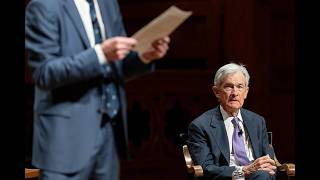
Federal Reserve Chair Jerome Powell speaks at Harvard University — 3/30/2026
Speakers
Jerome Powell
— Chair, Federal Reserve Board of Governors
David
— Host / Moderator
Summary
- Chair Powell frames the current monetary policy challenge as a tension between downside risks to the labor market and upside risks to inflation, making near-term policy decisions particularly difficult.
- He defends the Fed's use of Quantitative Easing (QE) as necessary post-GFC and during the pandemic to restore market function, though acknowledges macroeconomic effects are harder to quantify and disagrees with critics who cite significant negative side-effects like market dysfunction or inequality.
- Powell characterizes the period through late 2024 as a successful "soft landing," with inflation near 2%, strong growth, and full employment, achieved despite nearly universal economist predictions of a recession.
- Current inflation is being pressured by two distinct, smaller supply shocks: tariffs (adding 0.5-1.0%) and potential energy price spikes from the Middle East conflict. The Fed views its current policy stance as appropriate to "wait and see."
- On supply shocks, Powell outlines the standard Fed approach: tend to "look through" transient shocks due to policy lags, but must vigilantly monitor for any de-anchoring of inflation expectations, especially given inflation has been above target for several years.
- He clarifies the Fed's operational philosophy: monetary policy must remain fiercely independent and apolitical, while financial regulation, led by the Vice Chair for Supervision, is more collaborative and can shift with administrations, as mandated by Congress.
- Powell expresses confidence in a more resilient post-Dodd-Frank banking system with higher capital/liquidity but emphasizes constant vigilance, especially for emerging risks in non-bank finance (capital markets, private credit) and cybersecurity.
- On private credit specifically, he states the Fed is monitoring "super carefully" for connections to the banking system and contagion but currently does not see characteristics of a broader systemic event.
- Advising students on AI and the labor market, he acknowledges a "challenging time" for job seekers but is medium-to-long-term optimistic about U.S. productivity and dynamism, suggesting mastering new AI tools is crucial.
- Powell describes the Fed's decision-making process as eclectic, incorporating district bank insights ("looking out the window"), multiple models, and extensive dialogue, but stresses that models are only illustrative, not decisive.