Energy importers and exporters that could benefit from the war in the Middle East
Summary
- The conflict between the US/Israel and Iran is viewed as "fuel to the fire" for a weaker dollar and stronger Emerging Markets (EM) equity trade, rather than a reason to flee risk assets.
- There is a distinct bifurcation within Emerging Markets: Asia (80% of the index) is viewed as vulnerable because they are energy importers, whereas Latin America is favored as a value-oriented energy exporter.
- Investor sentiment remains risk-on, with 75% of advisors favoring equity risk for 2026 despite geopolitical tensions.
- International equities have captured over 40% of ETF flows year-to-date, marking a significant rotation away from US-centric exposure.
Ideas
Malcolm explicitly states they are "doubling down" on Latin America, specifically naming "Argentina... the tickers ARGT, Brazil... and Colombia." He notes these markets offer "value, high single-digit PE multiples... and exposure to commodities." The Middle East conflict drives energy and commodity prices higher. While Asian EMs import energy (a negative), Latin American countries are net exporters (a positive). Buying these specific country funds captures the commodity upside and "carry" without the direct geopolitical risk of the Middle East. LONG Latin American single-country ETFs to play the commodity boom and valuation gap. A rapid de-escalation in the Middle East causing oil prices to crash, or specific political instability within LatAm countries.
Cynthia discusses how investors might play the conflict: "Target say an oil fund like USO... or... XLE... or... AMLP, which is your MLPs, your pipelines." If the conflict sustains high oil prices, these are the three distinct ways to monetize it: USO for direct spot price exposure (high beta), XLE for equity upside (operational leverage), and AMLP for yield and lower volatility (infrastructure). LONG the Energy complex as a hedge against prolonged conflict. Supply chains remaining intact despite conflict, leading to oil price stagnation; regulatory headwinds for pipelines.
Malcolm Dorson
Head of Active Investment Team, Global X Funds
Malcolm notes that the broad EM index is "roughly 80% Asia... [which are] importers of energy." He mentions clients are asking to "monitor this sleeve" via an "EMX China strategy." Standard EM indices (like EEM) are heavily weighted toward China, Taiwan, and Korea. Since these nations import energy, rising oil prices hurt their margins. An "Ex-China" or active strategy avoids this concentration risk and the negative correlation to high oil prices. LONG Emerging Markets Ex-China (proxy ticker EMXC) to avoid the energy-import drag of Asian tech hubs. A resurgence in Chinese growth or a sudden drop in energy prices would make the broad index outperform the Ex-China strategy.
Up Next
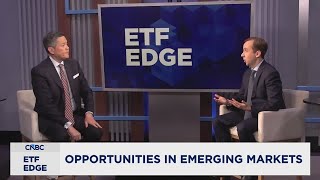



This CNBC video, published March 03, 2026, features Malcolm Dorson, Cinthia Murphy discussing EWZ, GXG, ARGT, XLE, USO, AMLP, EMXC. 3 trade ideas extracted by AI with direction and confidence scoring.
Speakers: Malcolm Dorson, Cinthia Murphy · Tickers: EWZ, GXG, ARGT, XLE, USO, AMLP, EMXC