Talk of War Resolution Fuels Market Rally | The Close 3/31/2026
Speakers
Carson Block
— CEO and Founder, Muddy Waters Research
Anna Andreeva
— Senior Research Analyst, Piper Sandler
Matt Harvey
— Economic Analyst
Jitania Kandhari
— Deputy CIO, Solutions and Multi-Asset Group, Morgan Stanley Investment Management
Deborah Weinswig
— CEO and Founder, Coresight Research
Tobin Marcus
— Wolfe Research
Erik Hirsch
— Co-CEO, Hamilton Lane
Ethan Klingsberg
— Partner and Co-Head of U.S. Corporate and M&A, Freshfields
Summary
- Carson Block argues the dominant, long-term market risk is AI-driven job displacement, which he believes will precede and trigger a "global financial crisis time" market cataclysm, exacerbated by passive fund outflows and illiquidity in credit ETFs.
- To express this macro view, Block's firm is positioned via long-dated, out-of-the-money put spreads on high-yield (HYG) and investment-grade (LQD) credit ETFs, expecting credit spreads to widen significantly before mass layoffs materialize.
- On Nike (NKE), Anna Andreeva is cautiously optimistic, citing a nine-year low stock price, progress in North America, and wholesale growth, but awaits clearer turnaround signals in China and the DTC channel.
- Matthew Harvey distinguishes between negative sentiment/liquidity issues in private credit vehicles (e.g., BDC redemptions) and constructive fundamentals in the broader, diversified middle-market lending economy, seeing current dislocation as a potential opportunity for new lenders.
- Jitania Kandhari views the Iran conflict as a manifestation of a multipolar world, with the key risk being the duration of the Strait of Hormuz closure, which would cause trade shock and force a global reallocation towards energy security investments.
- Deborah Weinswig is skeptical of Nike's near-term turnaround, highlighting intense competition from brands like New Balance and Hoka, and the significant cultural and strategic shift required to succeed in China against local competitors.
- Tobin Marcus is skeptical that recent headlines indicate a real diplomatic breakthrough in the Iran war, viewing the Iranian president's comments as non-influential and noting maximalist, non-overlapping demands from both sides make a near-term resolution unlikely.
- Erik Hirsch contends that fears over private credit are "massively overblown" and mispriced, arguing the asset class is too large and diverse (spanning software, manufacturing, healthcare) to be painted with a broad brush, and that institutional capital is not fleeing.
- Ethan Klingsberg anticipates continued strong M&A activity ("trophy" and "fear" deals) despite regulatory headwinds, and predicts pressure on software companies to consolidate or go private as large AI players go public and increase competitive scrutiny.
Ideas
Speaker states his firm has put on "long dated out of the money put spreads" on HYG and LQD to play the thesis that AI-driven job displacement will cause a credit market cataclysm. He believes AI will cause profound job losses in the knowledge economy, which will lead to 401(k) outflows from passive equity funds. This, combined with passive market mechanics, will crush equities and spill over into credit, causing spreads to widen sharply. Credit ETF underlying liquidity may dry up, exacerbating the downside. The trade structure (put spreads) is designed to avoid shorting and cap downside risk while positioning for a significant widening of credit spreads and a decline in these ETF prices. The timing of the AI job displacement is uncertain and could be years away; geopolitical events (like the Iran war) can distract the market and delay the thesis from being priced in.
Speaker maintains an Overweight rating, calling the stock at a nine-year low a "good risk return" for patient investors, but highlights key areas needing improvement: China initiatives and DTC channel demand. The turnaround is complex, but North America shows signs of progress and wholesale distribution is growing. For the stock to work, investors need to hear concrete plans to fix China and see the DTC channel—a true demand indicator—show sustained improvement. The stock is under-owned and at an attractive entry point for a turnaround, but it is not yet a clear "long" as critical pieces (China, DTC momentum) are still in need of proof points from management. Management fails to articulate a credible China turnaround strategy, and DTC growth remains weak, indicating underlying brand demand issues are not resolving.
Speaker distinguishes between "sentiment-driven" liquidity risk in retail private credit vehicles (BDCs) and "constructive fundamentals" in the broader private credit market, which finances the backbone of the economy. Current redemptions and gating in BDCs are creating a supply/demand imbalance, with less capital competing for new loans. This could lead to a "more rational" and attractive lending environment for disciplined, diversified lenders despite the negative headlines. The dislocation in retail vehicles presents a potential opportunity to originate new private credit loans at more attractive prices, favoring managers with scale and diversification. A severe economic downturn that impairs the fundamental credit quality of the underlying middle-market borrowers, turning a sentiment issue into a real loss issue.
Jitania Kandhari
Deputy CIO, Solutions and Multi-Asset Group, Morgan Stanley Investment Management
37:30
Speaker states the key variable is not war escalation but the "duration" of the Strait of Hormuz closure, which would cause a "trade shock" and force a reallocation of capital based on regional energy security. A prolonged closure would transmit through higher oil prices and benefit energy-exporting regions over importers. This shock would accelerate existing trends in a multipolar world, making energy security a primary investment theme and geographic decision factor (e.g., for data center build-out). Oil (and gas) are critical assets to monitor as the primary transmission mechanism for the conflict's economic impact, with price and inventory levels determining regional market winners and losers. A swift diplomatic resolution reopens the Strait, causing oil prices to correct and mitigating the trade shock and reallocation theme.
Up Next
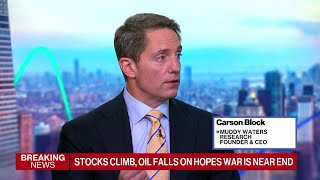
This Bloomberg Markets video, published March 31, 2026, features Carson Block, Anna Andreeva, Matt Harvey, Jitania Kandhari discussing LQD, HYG, NKE, XLF, WTI. 4 trade ideas extracted by AI with direction and confidence scoring.
Speakers: Carson Block, Anna Andreeva, Matt Harvey, Jitania Kandhari · Tickers: LQD, HYG, NKE, XLF, WTI