Ideas
AI-driven productivity gains support an earnings melt-up.
The stock market is experiencing an earnings-led melt-up supported by a calming Middle East and a 'Roaring 2020s' productivity boom driven by AI, which is increasing consumer purchasing power and economic growth without bursting any AI bubble.
Clip coupons at the front-end yield curve.
Investment-grade credit and the long end of the yield curve are uninteresting; instead, investors should focus on the front to belly of the yield curve to clip high coupons without compromising rating, while high-yield credit carries well.
Clip coupons at the front-end yield curve.
Persistent supply shocks and inflation will raise the term premium for longer-duration bonds, steepening the yield curve; investors should favor shorter-duration instruments, well-secured high-quality credit, non-dollar assets, and real visible assets.
Clip coupons at the front-end yield curve.
Persistent supply shocks and inflation will raise the term premium for longer-duration bonds, steepening the yield curve; investors should favor shorter-duration instruments, well-secured high-quality credit, non-dollar assets, and real visible assets.
Easy financial conditions favor emerging markets diversification.
Easy financial conditions and the physical constraints of the current geopolitical environment are driving demand for diversification into emerging markets and real assets, alongside continued strong investment in the AI cycle.
Easy financial conditions favor emerging markets diversification.
Persistent supply shocks and inflation will raise the term premium for longer-duration bonds, steepening the yield curve; investors should favor shorter-duration instruments, well-secured high-quality credit, non-dollar assets, and real visible assets.
Buy 10-year Bunds over 10-year Treasuries.
With the US facing potential safe-haven questions and Europe looking relatively stable with lower fiscal deficits, investors should prefer 10-year Bunds over 10-year Treasuries for sovereign debt exposure.
Supply disruptions will push steel prices higher.
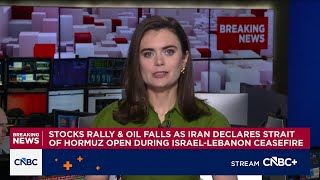
The ongoing closure of the Strait of Hormuz is causing a slow-moving physical supply crisis that will eventually reach the US, driving up prices for physical goods and specifically pushing steel prices higher.
Supply disruptions will push steel prices higher.
The ongoing closure of the Strait of Hormuz is causing a slow-moving physical supply crisis that will eventually reach the US, driving up prices for physical goods and specifically pushing steel prices higher.
Supply issues support a broad commodity stockpile.
Despite the market looking past near-term geopolitical risks, there are still physical supply issues, making the broader commodity theme attractive as countries and companies build stockpiles in an 'every man for himself' environment.
Avoid equities as valuations exceed prewar baselines.
The world is not safer or more prosperous due to the war, and with equity valuations now past their prewar baseline, the risk-reward is no longer justifiable, making it time to avoid equities.
Favor short-duration bonds and real visible assets.
Persistent supply shocks and inflation will raise the term premium for longer-duration bonds, steepening the yield curve; investors should favor shorter-duration instruments, well-secured high-quality credit, non-dollar assets, and real visible assets.
This Bloomberg Markets video, published April 17, 2026,
features Ed Yardeni, Rick Rieder, Joyce Chang, Amos Hochstein, Alex Altman, Daleep Singh
discussing SPY, XLK, HYG, TLT, LQD, SHY, EEM, GLD, BUND, JJU, STEEL, DBC, VTI, FXE.
12 trade ideas extracted by AI with direction and confidence scoring.
Speakers:
Ed Yardeni,
Rick Rieder,
Joyce Chang,
Amos Hochstein,
Alex Altman,
Daleep Singh
· Tickers:
SPY,
XLK,
HYG,
TLT,
LQD,
SHY,
EEM,
GLD,
BUND,
JJU,
STEEL,
DBC,
VTI,
FXE