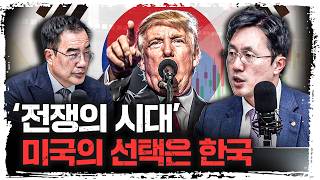
What Is Trump's Real Motive Behind His Obsession with Greenland? | Cho Han-bum, Chair Research Fellow at Korea Institute for National Unification

그린란드에 집착하는 트럼프의 진짜 속내는? | 조한범 통일연구원 석좌연구위원 [더 레드]
Watch on YouTube ↗  |  January 31, 2026 at 06:00  |  58:25  |  3PRO TV (삼프로TV)
Speakers
Cho Han-bum — Senior Research Fellow, Korea Institute for National Unification

Summary

Cho Han-bum, Chair Research Fellow at the Korea Institute for National Unification, argues that the world has entered a no-polarity era of disorder, with Trump pursuing oil hegemony and Western Hemisphere control while China faces internal risks and possible Taiwan invasion. He highlights Taiwan/TSMC geopolitical risk, Europe's rearmament, and Korea's strategic leverage in AI memory, power, nuclear, and manufacturing. The discussion frames these geopolitical shifts as key variables for investors and Korea's survival strategy.

  • Cho Han-bum describes a no-polarity era marked by weakened global order and strongman politics.
  • Trump's core strategic goals are oil/energy hegemony and Western Hemisphere control, including Venezuela, Iran, and Greenland.
  • China's debt, property, and employment problems raise the risk of a Taiwan invasion, especially around 2027.
  • Taiwan and TSMC are exposed to severe geopolitical risk, while US commitment remains uncertain.
  • Europe is rearming as NATO trust erodes, with Poland, Germany, and France increasing defense spending.
  • Korea's AI-era leverage lies in HBM memory, power grid, nuclear, shipbuilding, and manufacturing.
  • Europe holds a large share of US Treasuries, making potential coordinated selling a market risk to monitor.
  • The speaker recommends Korea negotiate from strength rather than bow to US pressure.
Ideas
Cho Han-bum Senior Research Fellow, Korea Institute for National Unification 22:59
China faces severe internal and war risk.
China faces severe internal economic and financial risks, including total government debt possibly near 300% of GDP, a property downturn, EV overcapacity, and high youth unemployment. Xi may use Taiwan unification and nationalism to divert these pressures, making Chinese assets vulnerable to both domestic and geopolitical risk.
Cho Han-bum Senior Research Fellow, Korea Institute for National Unification 29:00
Taiwan and TSMC face invasion risk.
China may invade Taiwan, with 2027 as a highly likely window because Xi wants unification within the new five-year plan and Taiwan is politically divided and militarily weak. The US may not fully defend Taiwan. TSMC and the Taiwan semiconductor supply chain are therefore exposed to severe geopolitical risk.
Cho Han-bum Senior Research Fellow, Korea Institute for National Unification 34:24
Trump's core goal is oil hegemony.
Trump's central strategic goal is oil and energy hegemony. He wants to control Venezuelan and Iranian oil, combine it with the US being the world's largest producer, neutralize Saudi/OPEC influence, and use oil prices to lower US inflation, pressure Russia, and contain China. This makes oil a key geopolitical policy variable to monitor.
Cho Han-bum Senior Research Fellow, Korea Institute for National Unification 47:16
Europe's Treasury holdings are leverage.
Denmark has decided to sell its US Treasuries after US pressure over Greenland, and Europe collectively holds about 40% of US Treasuries. If Europe were to sell in a coordinated way, it could collapse the US Treasury market, making this a key leverage point and risk to monitor.
Cho Han-bum Senior Research Fellow, Korea Institute for National Unification 48:08
Korea memory is critical for AI.
In the AI era, memory and HBM are indispensable. Without Korea's SK hynix and Samsung Electronics HBM, Nvidia and even TSMC cannot function. This gives Korea critical supply-chain leverage.
Cho Han-bum Senior Research Fellow, Korea Institute for National Unification 48:30
Korea power infrastructure benefits from AI.
The AI era's defining constraint is electricity. Korea has strengths in power transmission, distribution, and generation, which makes its power infrastructure sector a key beneficiary of AI-driven electricity demand.
Cho Han-bum Senior Research Fellow, Korea Institute for National Unification 49:02
Nuclear is needed for AI power.
AI data centers need massive electricity, but renewables alone cannot handle the load, so nuclear power is necessary. Korea is a nuclear power stronghold and should benefit from this demand shift.
Cho Han-bum Senior Research Fellow, Korea Institute for National Unification 49:15
Korea manufacturing wins in physical AI.
AI alone is not enough; physical execution through manufacturing is needed. Korea has a strong, integrated manufacturing belt spanning shipbuilding, machinery, and autos, while Taiwan lacks this heavy machinery base, giving Korea a durable competitive advantage.
Cho Han-bum Senior Research Fellow, Korea Institute for National Unification 54:06
Europe rearmament drives defense demand.
US credibility with NATO is broken, so European countries are shifting to self-defense and an arms race. Poland is already spending near 4-5% of GDP on defense, and Germany and France are likely to follow, driving demand for defense equipment.
Up Next

This 3PRO TV (삼프로TV) video, published January 31, 2026, features Cho Han-bum discussing FXI, TSM, WTI, TLT, 000660.KS, 005930.KS, Korean power grid/electric infrastructure, Korean nuclear power, Korean manufacturing/industrials, European defense sector. 9 trade ideas extracted by AI with direction and confidence scoring.

Speakers: Cho Han-bum  · Tickers: FXI, TSM, WTI, TLT, 000660.KS, 005930.KS, Korean power grid/electric infrastructure, Korean nuclear power, Korean manufacturing/industrials, European defense sector