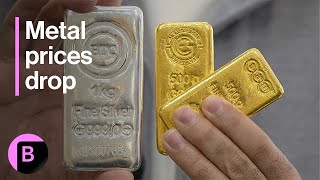
Gold & Silver Crash: What Sparked It and What’s Next | Insight with Haslinda Amin 02/02/2026

Watch on YouTube ↗  |  February 02, 2026 at 07:12  |  1:35:59  |  Bloomberg Markets
Speakers
Paul Dobson — Executive Editor, Bloomberg
Jeff Christian — Managing Partner, CPM Group
Aastha Gudwani — India Chief Economist, Barclays
Thu Ha Chow — Head of Content, The Block
Mike Szucs — CEO, Cebu Pacific
Stephen Stapczynski — Asia Energy Coverage, Bloomberg
Dennis Lockhart — Former Atlanta Fed President
Annabel Droulers — Anchor, Bloomberg TV
Xavier Shetty — Equities Options Reporter, Bloomberg
Alisha Sachdev — India Auto Reporter, Bloomberg
Awais Ahmed — Founder and CEO, Pixxel
Srinath Ravichandran — Co-founder and CEO, Agnikul Cosmos
Joumanna Bercetche — Anchor, Bloomberg

Summary

Insight reviewed a broad market selloff led by a historic gold and silver crash, with Kevin Warsh's Fed nomination, COMEX rollovers and speculative positioning cited as triggers. The program also assessed Nvidia's OpenAI investment uncertainty, India's budget and record bond issuance, rupee weakness and tax hikes on derivatives. Later segments covered India's rare earth and space ambitions, Cebu Pacific's operating outlook, and oil's drop as Iran risk premium faded amid oversupply concerns.

  • Gold and silver extended a historic crash after a speculative run-up, with COMEX rollovers, Kevin Warsh's Fed nomination, dollar strength and margin calls cited as drivers.
  • Jeffrey Christian stayed long-term bullish on both metals but warned near-term volatility and downside remained.
  • India's budget delivered record borrowing, a derivatives-tax hike and fiscal restraint while supporting manufacturing, rare earths and space.
  • Indian bonds and the rupee faced supply and FDI-outflow pressures, while Barclays and Robeco differed on Indian bond direction.
  • Nvidia's Jensen Huang clarified that a $100 billion OpenAI investment was not a commitment, weighing on tech and Korean semiconductor shares.
  • Cebu Pacific's CEO reported record traffic, 10% growth and easing engine issues, and expected softer oil to help airline costs.
  • Oil fell as Trump signaled talks with Iran, and analysts saw an oversupplied market with a fading geopolitical risk premium.
  • India's private space and rare earth sectors received budget attention, though speakers flagged technology bottlenecks and no clear public-market vehicle.
Ideas
Paul Dobson Executive Editor, Bloomberg 4:33
Dollar bearish as rest of world outperforms.
Dobson says the longer-term market view remains dollar bearish for the year because, while the US may fare reasonably well, the rest of the world may fare a little better. He notes near-term stabilization after Kevin Warsh's Fed nomination but expects the dollar could resume its downward momentum, especially against commodity currencies and the euro and pound.
Jeff Christian Managing Partner, CPM Group 13:04
Long-term bullish gold and silver.
Christian is long-term bullish on gold and silver because the economic and political problems that drive investors to buy physical metal are worsening, not improving, and global physical investment demand remains strong. He sees the recent spike as a speculative bubble with near-term volatility and possible downside from COMEX contract rollovers, but expects those macro and geopolitical drivers to push long-term gold and silver prices higher; he is especially bullish on silver's average price this year, though not from the $140 spike level.
Aastha Gudwani India Chief Economist, Barclays 34:54
RBI purchases support Indian government bonds.
Gudwani says India's record 17.2 trillion rupee gross borrowing is too large for the market to absorb on its own, so the RBI is becoming buyer of last resort and will need to step up bond purchases and OMOs. With inflation below target, she expects continued RBI bond purchases due to the demand-supply mismatch, which supports Indian government bonds despite heavy supply.
Aastha Gudwani India Chief Economist, Barclays 38:45
Rupee weak on relentless FDI outflows.
Gudwani says the rupee's weakness is not a current-account-deficit problem; it is driven by a shrinking capital-account surplus and relentless FDI equity outflows. The budget did not deliver the FPI tax reforms that could attract equity inflows, leaving the INR with a specific structural problem and limited policy support.
Thu Ha Chow Head of Content, The Block 52:28
Fed balance-sheet cuts hurt long Treasuries.
Chow says Kevin Warsh's focus on shrinking the Fed's 6.6 trillion dollar balance sheet could reduce support for the long end of the Treasury curve, steepen the curve, and raise financing costs. She caveats this with potential Fannie and Freddie mortgage-market support, but the mechanics point to less long-end support and tighter liquidity.
Thu Ha Chow Head of Content, The Block 55:54
Record Indian supply pressures government bonds.
Chow is more cautious on Indian government bonds because the budget's record borrowing means supply is rising sharply, about 18 percent more than last year. She thinks the supply pressure can steepen the India curve, making bond-market funding a near-term concern.
Thu Ha Chow Head of Content, The Block 57:13
India long-term bullish domestic manufacturing story.
Chow says India is ultimately a domestic story: if the government focuses on capex and the real economy, promising manufacturing data and domestic activity could make India a longer-term bullish story. She separates this from her near-term caution on Indian bond funding.
Mike Szucs CEO, Cebu Pacific 82:03
Cebu Pacific growth with lower unit costs.
Szucs says Cebu Pacific came off a record year with 27 million passengers and 10 percent growth, and expects similar or slightly higher growth this year. He sees lower unit costs from fuel tailwinds, higher-density A320 and A330 seating, and easing Pratt & Whitney engine and grounding issues, supporting the carrier's operating outlook.
Mike Szucs CEO, Cebu Pacific 84:41
Oil softens, helping airline fuel costs.
Szucs expects oil to soften over the next year or so because the natural trend is down, with only geopolitical flare-ups causing spikes. Lower fuel costs would help Cebu Pacific and the airline industry.
Stephen Stapczynski Asia Energy Coverage, Bloomberg 92:51
Oil faces oversupply, bearish base case.
Stapczynski says the oil market is heading into a large oversupply as OPEC+ and US shale output remain strong, Chinese demand is uneven, and a possible Russia-Ukraine breakthrough could add more Russian barrels. With the Iran risk premium fading, he expects the market to flip into a more bearish scenario, making oil downside the base case unless there is a supply shock or Strait of Hormuz disruption.
Up Next

This Bloomberg Markets video, published February 02, 2026, features Paul Dobson, Jeff Christian, Aastha Gudwani, Thu Ha Chow, Mike Szucs, Stephen Stapczynski discussing USD, GLD, SILVER, India government bonds, Indian rupee, TLT, INDA, CEB, WTI, BNO. 10 trade ideas extracted by AI with direction and confidence scoring.

Speakers: Paul Dobson, Jeff Christian, Aastha Gudwani, Thu Ha Chow, Mike Szucs, Stephen Stapczynski  · Tickers: USD, GLD, SILVER, India government bonds, Indian rupee, TLT, INDA, CEB, WTI, BNO