Fed Holds Rates, Micron Reports Results | Closing Bell
Speakers
Romaine Bostick
— Anchor, Bloomberg
Carol Massar
— Anchor, Bloomberg
Tim Stenovec
— Anchor/Co-Host, Bloomberg TV & Radio
Summary
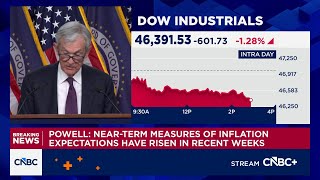
- The Federal Reserve held interest rates steady, with Chair Jay Powell signaling a patient, data-dependent approach, contributing to a broad equity market sell-off.
- Micron reported Q2 adjusted revenue of $23.86B versus a $19.74B estimate, with adjusted gross margin of 74.9% and cash flow from operations of $11.9B, all significantly beating expectations.
- Q3 revenue guidance of $32.75B to $34.25B far exceeded the $23.66B estimate, yet the stock price rose only modestly (~2%), suggesting high expectations or investor skepticism.
- Memory chip demand is structurally supported by the shift to AI inference, with Micron benefiting from its DRAM and HBM (high-bandwidth memory) offerings.
- Capacity constraints are a key risk; Micron's manufacturing expansion, including a New York facility, may not be operational until 2028, raising timing concerns.
- Soaring memory prices due to supply shortages are driving Micron's margins, but sustained high prices could eventually lead to demand destruction.
- Nvidia, representing 17% of Micron's revenue, possesses pricing power that may allow it to pass on costs, indirectly supporting Micron's pricing environment.
- Geopolitical tensions in the Middle East pose supply chain risks for critical chemicals used in semiconductor production.
- The memory industry is historically cyclical, and while current growth is seen as structural, long-term sustainability remains uncertain.