Ideas
HSBC reported a profit beat driven by its wealth division. The CEO explicitly stated, "We are confident in our ability to meet our upgraded targets" and announced a dividend increase. He dismissed Hong Kong commercial real estate concerns as cyclical, not structural. The market was pricing in heavy distress from Hong Kong real estate exposure. The earnings beat and dividend hike signal that the bank's diversified wealth income is successfully offsetting credit impairments, forcing a repricing of the stock as "safety" rather than "distress." LONG. The bank is executing a successful pivot to wealth management while the market remains overly pessimistic on its Asian real estate book. A deepening of the Chinese property crisis beyond current provisions.
Joumanna cites a UBS report expecting a "15% default rate in the private credit space." Ben Powell acknowledges the risk, stating investors need to be "appropriately paranoid" and that active selection is critical. While BlackRock argues this isn't systemic *yet*, a 15% default rate is significantly higher than historical norms. This suggests a "cockroach" theory—where there is one default, there are likely many more hidden in opaque private valuations. WATCH / AVOID. It is too early to short the whole sector (as big players have diverse books), but avoiding exposure to generic private credit funds is prudent until the default cycle peaks. If the economy accelerates (soft landing), these defaults may be absorbed without contagion.
The "AI Scare Trade" (selling software due to displacement fears) is fading, but the "Picks and Shovels" trade is accelerating. Joumanna notes the ratio of the Semiconductor Index to the Nasdaq is climbing. Minmin highlights that "Tech giants like Samsung, SK Hynix... [are] helping to lift the index." Investors are distinguishing between the *application* layer (risky/disruptable) and the *infrastructure* layer (essential). The demand for compute and memory is physical and immediate, regardless of which AI software model wins. LONG. Capital is concentrating in the upstream hardware providers, specifically memory and foundries. Regulatory caps on chip exports or a sudden cooling in AI capex spending.
Ben Powell states the AI boom is leading to "shortages of copper." Pål Kildemo (EGA CFO) notes that because "the price of copper is very high... we are seeing a lot of customers that used to use copper now moving onto aluminum." This is a classic substitution trade. AI and data centers require massive electrification (Copper). As Copper becomes prohibitively expensive due to shortages, industrial demand shifts to the next best conductor (Aluminum) for non-critical wiring, creating a structural tailwind for Aluminum prices independent of general economic growth. LONG. Own the scarcity (Copper) and the substitute (Aluminum). A global recession crushing industrial demand or rapid expansion of mining supply (unlikely in the short term).
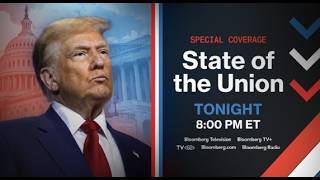
President Trump doubled down on tariffs, calling them a "successful path" and criticizing the Supreme Court ruling. He implemented a 15% global blanket tariff. Ben Powell notes this ensures "ongoing inflation pressures in the goods sector." A 15% blanket tariff directly hits importers' margins. Retailers must either absorb the cost (crushing earnings) or pass it on (crushing demand). With "affordability" already a key political issue, consumer elasticity is likely low, meaning volumes will drop. SHORT. Import-heavy retailers face a dual headwind of margin compression and demand destruction. If the tariffs are struck down permanently by the courts or revoked, retail stocks would rally hard.
This Bloomberg Markets video, published February 25, 2026,
features Georges Elhedery, Joumanna Bercetche, Ben Powell, Donald Trump
discussing HSBC, BKLN, NVDA, TSM, SOXX, JJU, AA, COPPER, CENX, XRT, XLY.
5 trade ideas extracted by AI with direction and confidence scoring.
Speakers:
Georges Elhedery,
Joumanna Bercetche,
Ben Powell,
Donald Trump
· Tickers:
HSBC,
BKLN,
NVDA,
TSM,
SOXX,
JJU,
AA,
COPPER,
CENX,
XRT,
XLY