Ideas
Constructive on US equities via earnings.
She is positive on the U.S. equity market because the macro backdrop is constructive and earnings should drive low-double-digit returns; multiple expansion is not expected, and bond yields must stay fairly well behaved to avoid a hurdle.
Global diversification favors non-US equities.
Concerns about the U.S. outlook and a desire for global diversification are increasing momentum toward markets outside the U.S., where she sees fundamental strengths; this is not a flood out of the U.S., but it adds to the attractiveness of other markets.
Drones are the future of warfare.
After Ukraine, warfare has changed and drones are where the future is; nimble, cheaper weapons are more relevant than traditional large defense projects, so defense investment should favor drones.
Favor developed ex-US industrial renaissance.
He wants to be part of the industrial renaissance outside the U.S., especially Europe/Germany/U.K. where government demand for capital exceeds their ability to participate, and in Japan and Australia where similar opportunities exist.
Long-duration credit demand absorbs supply.
Record investment-grade and high-yield net issuance should be absorbed because real yields are historically high and global pension/investors need long-duration yield, creating a powerful supply-demand mix; he still remains cautious as a credit investor.
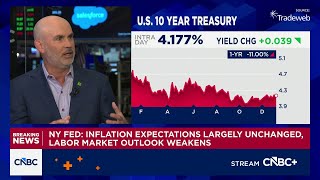
10-year Treasury yield drifts higher.
She expects the 10-year Treasury yield to grind slightly higher, to roughly 4%-4.5%, because growth could be hot-then-cold and K-shaped, inflation remains sticky, tariffs and deficits persist, and Fed credibility/independence issues put a floor under yields, though she does not expect a huge spike.
Magnificent Seven edge is fading.
The Magnificent Seven is becoming a fading concept: each year fewer mega-cap tech names are driving S&P 500 outperformance, and earnings strength is broadening to other sectors, so she would not rely on concentrated Mag Seven leadership.
Financials are favored broadening counterweight.
She likes financials as a counterweight to narrow AI/tech leadership, supported by a favorable macro backdrop, a potentially steepening yield curve, and deregulation; broadening in earnings also helps the sector.
Bullish homebuilders for a better 2026.
He expects 2026 to be a better year for housing and is decidedly bullish on homebuilders: inventories have stabilized, mortgage rates are down about 100 bp, cost inflation is moderating, estimates have been cut, and valuations are around 9x. He would buy weakness.
Big Tech still leads earnings growth.
He expects Big Tech to outperform consensus and drive the bulk of roughly 11% S&P 500 earnings growth; core tech businesses remain strong, AI adoption mainly benefits the tech industry itself, and meaningful broadening into the rest of the U.S. market is unlikely, making this a long-term tech cycle.
Utilities favored as AI-adjacent winners.
He likes utilities alongside Big Tech as part of the narrow AI/tech-related leadership; they are beneficiaries of the tech-related trend while broader U.S. equity market broadening remains limited.
Financials benefit from capital markets.
He likes financials because they are benefiting from capital markets activity, and they are among the preferred pockets of leadership along with utilities and Big Tech while U.S. market broadening is limited.
Avoid consumer discretionary and staples.
He is cautious on consumer discretionary and staples: consumer sentiment is low, discretionary is not out of the woods, staples lack pricing power, and tariff pass-through uncertainty is starting to show up in pockets, limiting hopes for meaningful market broadening.
This Bloomberg Markets video, published January 08, 2026,
features Seema Shah, Douglas Rediker, Jim Zelter, Meera Pandit, John, Venu Krishna
discussing SPY, Non-U.S. equities, ITA, VGK, EWJ, EWA, Long-duration credit, U.S. 10-year Treasury yield, MAGS, XLF, XHB, XLK, UTILITIES, XLP, XLY.
13 trade ideas extracted by AI with direction and confidence scoring.
Speakers:
Seema Shah,
Douglas Rediker,
Jim Zelter,
Meera Pandit,
John,
Venu Krishna
· Tickers:
SPY,
Non-U.S. equities,
ITA,
VGK,
EWJ,
EWA,
Long-duration credit,
U.S. 10-year Treasury yield,
MAGS,
XLF,
XHB,
XLK,
UTILITIES,
XLP,
XLY