Ideas
Gap Inc. (GPS) reported sales fell 10%, with Old Navy specifically struggling. The consumer is bifurcated; while premium brands (Banana Republic) did okay, the mass-market segment (Old Navy) is cracking. This signals weakness in the lower-end consumer, which is bearish for the stock. Short/Avoid due to deteriorating fundamentals and consumer weakness. Turnaround efforts or a buyout rumor could spike the stock.
Marvell Technology (MRVL) shares soared 12% after raising their outlook due to stronger-than-expected growth in custom AI silicon. While general GPU makers (NVDA/AMD) face export restrictions, MRVL's custom ASIC business for data centers is showing idiosyncratic strength, allowing it to decouple from the broader semi weakness. Long on earnings momentum and specific data center exposure. Broader tech sell-off dragging down high-beta names.
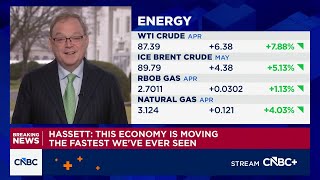
WTI Crude has broken $86 and Brent is near $90. Goldman Sachs (Struyven) notes that if the Strait of Hormuz remains closed for 5 weeks, prices could rise by $100/bbl. Small-cap Battalion Oil (BATL) is up 300% on the week tracking this move. The physical constraint of oil flow (3.3m to 5m barrels/day shut in) creates a supply shock 50x larger than the 2022 Russia crisis. US producers with secure logistics (Permian/Majors) benefit directly from the global price spike without the Strait's transit risk. Long US-based production to capture the geopolitical premium. A sudden ceasefire or "unconditional surrender" (as demanded by Trump) leading to a rapid price collapse.
The US Commerce Department is drafting rules to restrict AI chip shipments to *anywhere* in the world without specific approval, effectively making the US government the "gatekeeper." This expands export controls beyond just China to a global scope, significantly increasing regulatory friction and potentially capping total addressable market (TAM) velocity for high-end AI chips in the short term. Avoid/Short on regulatory headwinds despite the secular AI trend. The rules may be watered down or enforcement may be lax; AI demand is so high that buyers will jump through any hoop.
The 10-year Treasury yield pushed toward 4.25% - 4.50% early in the session. Subsequently, payrolls printed a shocking -92k jobs. Misra argues that 4.25% is a "buy zone" because the oil shock acts as a tax on the consumer, eventually destroying demand. Collins agrees, viewing 4.50% as an overshoot and fair value closer to 3.50%-4.00% as the Fed is forced to cut to save the labor market. Long Duration. The weak payrolls print confirms the "bad news is good news" for bonds thesis, overriding short-term inflation fears from oil. Stagflation where the Fed is forced to hike/hold despite weak growth due to unanchored inflation expectations.
South Korean markets sold off aggressively due to fears over oil imports (Korea is a net energy importer). Lovell argues the sell-off is an overreaction. The core thesis for South Korea is memory chips/AI (Samsung/SK Hynix), which remains intact. The energy tax is painful but doesn't break the secular demand for memory. Long South Korea (EWY) as a contrarian play on the dip. Prolonged oil shock causes a global recession, crushing demand for electronics/chips.
This Bloomberg Markets video, published March 06, 2026,
features Yahaira (Bloomberg Brief), Jonathan Ferro, Priya Misra, Nadia Lovell
discussing GPS, MRVL, XOM, CVX, BATL, AMD, NVDA, TLT, IEF, EWY.
6 trade ideas extracted by AI with direction and confidence scoring.
Speakers:
Yahaira (Bloomberg Brief),
Jonathan Ferro,
Priya Misra,
Nadia Lovell
· Tickers:
GPS,
MRVL,
XOM,
CVX,
BATL,
AMD,
NVDA,
TLT,
IEF,
EWY