Iran Says US Deal Not Imminent | The Pulse 5/25/2026

Watch on YouTube ↗  |  May 25, 2026 at 10:06  |  48:34  |  Bloomberg Markets
Speakers
Marco Valli — Chief European Economist, UniCredit
Ven Ram — Markets Live Reporter/Strategist, Bloomberg
Alex Karnal — Partner, Andreessen Horowitz
Tufan Erginbilgiç — CEO, Rolls-Royce

Summary

The May 25, 2026 episode of The Pulse with Francine Lacqua covers conflicting signals on a US-Iran deal and its implications for oil prices, the widening transatlantic economic gap, and ECB rate hike expectations. It also reports on Turkey's political crisis, Huawei's chipmaking breakthrough, and features interviews on investment in AI-driven healthcare and Rolls-Royce's turnaround.

  • Iran denies a deal is imminent despite US optimism, keeping oil market volatile.
  • Marco Valli of UniCredit expects oil around $100 until deal clarity, then gradual easing.
  • Ven Ram of Bloomberg MLIV recommends long-duration German bonds and UK Gilts, while avoiding JGBs.
  • ECB June rate hike is seen as a done deal due to rising inflation forecasts.
  • Turkey's political instability deepens with police raiding opposition party headquarters.
  • Huawei claims a chipmaking breakthrough that could narrow the gap with TSMC by 2031.
  • Alex Karnal of Braidwell highlights AI's transformative impact on healthcare and GLP-1 trends.
  • Rolls-Royce CEO discusses resilience and the need for small modular reactors in Europe.
Trade Ideas
Marco Valli Chief European Economist, UniCredit 3:56
Oil stays elevated then eases slowly
Oil prices will stay around $100 per barrel until there is clear confirmation of the Iran deal and the Strait of Hormuz begins to reopen. After that, energy prices will start easing gradually from early summer but will not fall back to pre-conflict levels anytime soon because the market will continue to price in a high risk premium due to ongoing political instability in the Middle East.
Ven Ram Markets Live Reporter/Strategist, Bloomberg 20:49
Long German bonds for safety
German bonds are a safe haven because German and Eurozone inflation may be more resilient than elsewhere, and the ECB looks more agile than the Fed or Bank of England. The premium of German bonds over U.S. Treasuries (15–30 basis points) is well-founded and sustainable, making long-duration German bonds attractive.
Ven Ram Markets Live Reporter/Strategist, Bloomberg 21:51
Avoid JGBs due to inflation
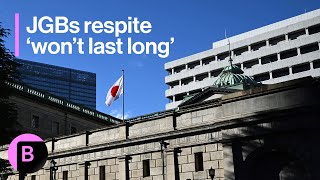
Japanese Government Bonds (JGBs) will trade at a significant discount to U.S. Treasuries because the Bank of Japan is far behind the neutral rate, and the damage from inflation will persist. Even after the war, JGBs are likely to be the most discounted securities among major bond markets.
Ven Ram Markets Live Reporter/Strategist, Bloomberg 22:11
Long 30-year Gilts after politics clears
Long-duration 30-year UK Gilts are attractive once the near-term political drama in Downing Street resolves. Net of inflation, investors are adequately compensated, and the current discount will narrow. After the storm blows over, there is a case to be invested in 30-year Gilts.
Up Next

This Bloomberg Markets video, published May 25, 2026, features Marco Valli, Ven Ram discussing BNO, German Government Bonds (Bunds), JGBUX, UK 30-Year Gilts. 4 trade ideas extracted by AI with direction and confidence scoring.

Speakers: Marco Valli, Ven Ram  · Tickers: BNO, German Government Bonds (Bunds), JGBUX, UK 30-Year Gilts