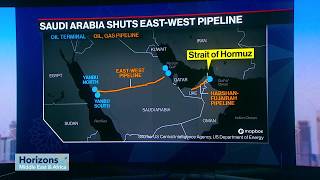
Shutdown of Saudi Pipeline Deepens Energy Crisis

Watch on YouTube ↗  |  September 14, 2026 at 05:26  |  46:18  |  Bloomberg Markets
Speakers
Robert Abu Omar — Middle East Correspondent, Bloomberg
Iqbal Z. Ahmed — Chairman, Pakistan GasPort
Robert Lee — Senior Analyst, Bloomberg Intelligence
James Danly — Deputy Secretary, U.S. Department of Energy
Anthony Stevens — Bloomberg Market Producer
Haslinda Amin — Anchor, Bloomberg Television

Summary

The video covers a Middle East energy shock after Saudi Arabia shut its East-West pipeline, plus the impact of US AI leaders' calls to slow frontier AI development on Asian chip stocks. Guests discuss LNG affordability and long-term demand destruction, China-US AI competition, US energy export and nuclear policy, and positioning risks in the AI trade. Market implications center on elevated oil and LNG prices, pressure on Asian semiconductors, and a bifurcated AI investment landscape.

  • Saudi Arabia shut its East-West pipeline after attacks, adding to oil supply concerns.
  • US AI leaders called for slowing frontier model development, pressuring Asian chip stocks.
  • Pakistan GasPort's chairman warned high LNG prices are destroying long-term demand and hurting emerging markets.
  • Bloomberg Intelligence's Rob Lee said China is well placed in AI and warned on hyperscaler concentration risk.
  • US Deputy Energy Secretary James Danly promoted US LNG exports, nuclear/SMR technology, and long-term energy contracts.
  • Bloomberg's Anthony Stevens flagged weakness in Asian chipmakers, Kioxia, and SoftBank.
  • Market participants remain focused on oil, AI CapEx, Fed risk, and Middle East geopolitics.
Ideas
Robert Abu Omar Middle East Correspondent, Bloomberg 5:04
Saudi pipeline shutdown lifts Brent crude
Saudi Arabia shut its East-West pipeline after drone attacks, removing a key alternative to the Strait of Hormuz; the Iran-Gulf meeting was postponed, Saudi August exports were the lowest since 2017, and this combination is contributing to the rise in Brent crude and broader energy prices.
Iqbal Z. Ahmed Chairman, Pakistan GasPort 9:26
US LNG exporters can target South Asia
The US is the world's largest oil and gas producer and has reauthorized over 17 BCF/day of additional LNG exports; the administration is pushing rapid production and export buildout to supply allies, keep prices low, and act as the world's energy breadbasket.
Iqbal Z. Ahmed Chairman, Pakistan GasPort 10:22
High LNG prices destroy future demand
High LNG prices and profiteering risk destroying long-term demand because consumers in emerging markets cannot afford $27 MMBtu and are shifting toward solar, wind, and coal; he says LNG is not viable for emerging markets and the industry may undermine its own future.
Iqbal Z. Ahmed Chairman, Pakistan GasPort 17:31
Henry Hub cheaper than Brent-linked LNG
Qatar-linked LNG is priced off Brent, while Henry Hub remains below $4; Pakistan would be better off linking long-term US supply to Henry Hub, with transportation the main negative, making US gas-linked supply ideal if logistics work.
Robert Lee Senior Analyst, Bloomberg Intelligence 20:26
Hyperscaler concentration is tangible market risk
The AI existential-risk debate is overdone; the real systemic risk is the huge concentration in financial markets around hyperscalers and related AI infrastructure, which is a tangible risk today.
Robert Lee Senior Analyst, Bloomberg Intelligence 22:20
China AI well placed long term
Chinese AI developers have narrowed the performance gap with the US to roughly 5%, have good talent, government support, and a long-term plan; if US companies slow down, Chinese companies will likely double down, leaving China well placed over the next 5-10 years.
James Danly Deputy Secretary, U.S. Department of Energy 31:45
Nuclear SMRs are energy game changer
The US is sharing nuclear technology, including gigawatt-scale reactors and new small modular reactors; SMRs turn reactor construction into a routinized manufacturing process with declining costs, and the diverse American SMR fleet should be globally dominant and a game changer for Asian energy demand.
Anthony Stevens Bloomberg Market Producer 43:01
AI slowdown pressures Asian chip stocks
Calls by US AI leaders to slow frontier development are forcing investors to reprice the AI CapEx cycle; if spending visibility for 2027-2028 fades, Asian chipmakers and semiconductor supply-chain names lose the huge earnings and cash-flow wall created by the competitive AI buildout.
Anthony Stevens Bloomberg Market Producer 43:47
Kioxia needs high memory prices
Kioxia is a Japanese memory play that needs very high memory prices to maintain its current share price, so it is especially vulnerable if AI-driven memory demand or pricing expectations are repriced lower.
Anthony Stevens Bloomberg Market Producer 43:56
SoftBank exposed to OpenAI IPO timing
SoftBank is an extremely long-duration play on OpenAI; any delay in OpenAI coming to market or IPO would be needle-moving for SoftBank and contributes to the stock's weakness.
Up Next

This Bloomberg Markets video, published September 14, 2026, features Robert Abu Omar, Iqbal Z. Ahmed, Robert Lee, James Danly, Anthony Stevens discussing BNO, US LNG exporters, LNG, Henry Hub Natural Gas, SKYY, China AI, Small modular reactors, URA, Asian chip stocks, 285A.T, SFTBY. 10 trade ideas extracted by AI with direction and confidence scoring.

Speakers: Robert Abu Omar, Iqbal Z. Ahmed, Robert Lee, James Danly, Anthony Stevens  · Tickers: BNO, US LNG exporters, LNG, Henry Hub Natural Gas, SKYY, China AI, Small modular reactors, URA, Asian chip stocks, 285A.T, SFTBY