This Weekend | Strait of Hormuz Ultimatum, ICE Agents at Airports, More on Iran
Speakers
David Gura
— Host, Bloomberg This Weekend
Christina Ruffini
— Host, Bloomberg This Weekend
Lisa Mateo
— Reporter, Bloomberg
Ethan Bronner
— Bloomberg Israel Bureau Chief
Skyler Woodhouse
— Reporter, Bloomberg News
Philip Crowther
— Reporter
Dustin Meyer
— Senior Vice President, Policy, Economics & Regulatory Affairs, American Petroleum Institute (API)
Yechiel Leiter
— Israeli Ambassador to the U.S.
Ian Bremmer
— President and Founder, Eurasia Group
Alex Rodriguez
— Former Baseball Player & Businessman
Pierre Poilievre
— Conservative Leader of Canada
Rep. Glenn Ivey
— Democrat, U.S. House of Representatives (Appropriations Committee)
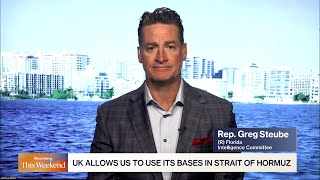
Greg Steube
— U.S. Representative
Myles Miller
— Reporter/Bloomberg Contributor
Eric Bazail-Eimil
— National Security Reporter, Politico
Jason Beeferman
— Reporter, Politico
Stuart Paul
— Bloomberg Economist
Martha Gimbel
— Former White House Council of Economic Advisers Senior Advisor (Biden Administration)
Summary
- President Trump issued a 48-hour ultimatum for Iran to reopen the Strait of Hormuz without threat, threatening to strike and "obliterate" Iranian power plants if not complied with, representing a significant escalation in rhetoric and potential military action.
- The ongoing conflict between Israel and Iran has resulted in over 4,000 deaths. Israel's Defense Minister indicated the joint campaign with the U.S. would intensify, with Prime Minister Netanyahu stating Israel is "halfway" through the war, suggesting a timeline of several more weeks.
- Iran is controlling the Strait of Hormuz, offering safe passage to non-"enemy" countries, potentially for a fee, while blocking ships affiliated with the U.S., Israel, and their allies. Deals for passage have been made with countries like Japan, India, and Pakistan.
- Oil and natural gas prices have surged to multi-year highs due to the conflict. The disruption at the Strait of Hormuz, a critical chokepoint, is the primary driver, with the duration of the closure being the key unknown variable for markets.
- Significant collateral damage includes a 17% loss of Qatar's LNG export capacity (approx. $20B revenue loss, repairs taking years) and a backlog of fertilizer shipments, disrupting the U.S. planting season and global agriculture supply chains.
- A partial government shutdown has left TSA workers unpaid for five weeks, leading to staff shortages, long airport security lines (e.g., 153 mins at Atlanta), and operational chaos during spring break. President Trump threatened to deploy ICE agents to airports starting Monday to assist and to look for undocumented immigrants.
- The U.S. is reportedly preparing a ~$200B supplemental funding request for the Pentagon related to the war, which faces significant congressional skepticism and would require offsets, making its passage uncertain.
- U.S. energy production and its status as a net exporter provides a buffer against global oil market volatility, but the immediate price impact on American consumers is already being felt and is a growing political concern.
- The conflict risks a longer-term rupture in U.S.-European alliances, as European nations are heavily dependent on the Strait of Hormuz but are unwilling to commit forces amidst the current fighting and distrust of U.S. leadership.
- Former FBI Director Robert Mueller has died at age 81. President Trump posted on social media, "Good, I am glad he is dead. He can no longer hurt innocent people!", drawing bipartisan criticism.
Ideas
The reporter noted that fertilizer shipments are backlogged due to the Strait of Hormuz closure, coinciding with the start of the U.S. planting season. Farmers, already navigating tariff uncertainties, face major disruptions if they can't access ordered fertilizer, potentially forcing them to seek new, last-minute suppliers like Venezuela. Agricultural inputs are a critical, time-sensitive component of the food production supply chain. A protracted closure of a key maritime route disrupts global fertilizer logistics, creating scarcity and cost pressures for farmers, which can translate into lower yields or higher food prices. WATCH Process Industries (specifically fertilizers and agricultural chemicals). The situation presents a clear, near-term supply shock risk to a vital industry segment. Market participants should monitor for price spikes in fertilizer commodities and potential earnings impacts on companies in the agricultural input space. The U.S. administration successfully facilitates alternative fertilizer supply routes (e.g., through Venezuela licenses) quickly enough to mitigate the planting season impact.
Dustin Meyer
Senior Vice President, Policy, Economics & Regulatory Affairs, American Petroleum Institute (API)
54:09
Oil and gas prices have hit their highest level in years directly due to the conflict and the closure of the Strait of Hormuz. The API SVP stated the disruption's impact is a "function of scale times duration," with duration being the unanswered question. The Strait of Hormuz is a irreplaceable chokepoint for global seaborne oil and LNG trade. A physical blockage or high-risk premium for transit directly constrains supply and injects volatility into global benchmark prices. Every day the Strait is not fully open extends the period of market stress. WATCH Oil & Gas. Prices are directly tethered to geopolitical developments in the region. The market is currently pricing in significant disruption risk, which could intensify if the U.S. ultimatum passes without the Strait reopening or if infrastructure like Qatari LNG facilities sustain long-term damage. Iran capitulates to the U.S. ultimatum and reopens the Strait fully within the 48-hour window, leading to a sharp correction in prices as the immediate disruption threat eases.
Up Next

This Bloomberg Markets video, published March 22, 2026, features Skyler Woodhouse, Dustin Meyer discussing DBA, XLE. 2 trade ideas extracted by AI with direction and confidence scoring.
Speakers: Skyler Woodhouse, Dustin Meyer · Tickers: DBA, XLE