It's still a pretty weak labor market with very little job growth, says Goldman Sachs' Jan Hatzius
Speakers
Jan Hatzius
— Chief Economist, Goldman Sachs
Summary
- The US labor market is significantly weaker than headline numbers suggest; excluding the healthcare sector, job growth is effectively zero or negative.
- An energy price shock is currently unfolding, which complicates the inflation picture and adds a drag on growth.
- While not officially in a "stagflationary" environment yet, recent economic shocks are directionally pointing toward stagflation (slowing growth + rising prices).
- Goldman Sachs notes that recession risk is "obviously going higher" from their previous estimates, driven by the deteriorating labor data and external shocks.
Ideas
Hatzius states, "If I do take an average though, it's still pretty weak labor market... zero job growth or negative rather negative job growth. If you take out health care." If the entire labor market's growth is concentrated solely in healthcare, the rest of the economy (cyclicals, consumer discretionary) is contracting or stagnant. Healthcare becomes the only defensive sector with actual fundamental momentum and demand. LONG Healthcare (XLV) as a defensive sector rotation in a slowing economy. Regulatory changes or policy shifts affecting healthcare reimbursement rates.
Hatzius explicitly mentions, "And now of course, we're getting an energy price shock which is unfolding." An "energy price shock" implies a rapid rise in oil and gas prices. While this is bad for the broader economy (consumer tax), it directly expands margins and free cash flow for energy producers. LONG Energy Sector (XLE) to capture the upside of the unfolding price shock. Demand destruction from a recession could eventually cap oil prices despite the supply shock.
When asked about stagflation, Hatzius admits, "Directionally, that's where of course the recent shocks have been have been going... the shocks have been pointing that way." Stagflation (low growth + high inflation) is the worst environment for standard equities (stocks) and bonds. Historically, Gold is the primary hedge against stagflationary environments where real rates may remain suppressed while growth falters. LONG Gold (GLD) as a macro hedge against the rising probability of stagflation. If the Federal Reserve keeps rates significantly higher to fight inflation, it raises the opportunity cost of holding non-yielding assets like Gold.
Up Next


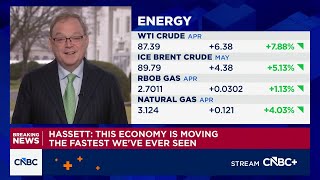


This CNBC video, published March 06, 2026, features Jan Hatzius discussing XLV, XLE, GLD. 3 trade ideas extracted by AI with direction and confidence scoring.
Speakers: Jan Hatzius · Tickers: XLV, XLE, GLD