Ideas
Cummins engines can power AI.
Cummins can produce about a million diesel engines a year, and those engines can be repurposed to generate electricity. That makes Cummins a flexible potential beneficiary of AI power bottlenecks, especially for non-aesthetic deployments in places like West Texas.
ASML is critical chip bottleneck.
ASML is the only viable producer of EUV lithography machines, shipping roughly 50-60 per year at around $350 million each, and leading-edge fabs need dozens of them. Its own supply chain for lenses, glass, and components with Zeiss and others is not diversified, making it a bottleneck within the chip bottleneck and giving it strong strategic leverage.
TSMC controls advanced-node bottleneck.
TSMC controls about 90% of the advanced-node market while Samsung and Intel lag. Leading-edge fabs cost tens of billions and take 3-5 years to build plus 12-18 months of yield ramp, and TSMC's engineering intellectual capital cannot be easily transferred, making it the real bottleneck for hyperscaler AI demand.
Meta benefits from AI ads.
Meta is a major beneficiary of AI advancements through its accelerating ads market, as AI improves recommendation and ad targeting.
Hyperscaler capex drives Nvidia super-cycle.
Hyperscaler capex from Google and Amazon is blowing away even optimistic Nvidia expectations, Amazon will buy a lot of Nvidia GPUs, Blackwell/GB200 is ramping at OpenAI, and H100/B200 pricing has firmed up, supporting the Nvidia super-cycle.
AI will use software tools.
AGI and advanced AI will use established software tools rather than reinvent them, just as robots use screwdrivers and hammers. That supports demand for enterprise software like ServiceNow, SAP, Cadence, and Synopsys.
Agents may rebuild expensive software.
Agents will use incumbent software such as Salesforce while it is cheap, but once SaaS pricing becomes expensive, it becomes cheaper for agents to build a specific workflow or clone the tool themselves, eroding software pricing power.
Systems of record face pricing pressure.
Systems of record become less sticky when agents can work around them and switch providers, creating massive pricing pressure. SaaS companies need to show insane AI-native revenue growth or investors will not have a compelling reason to own them during this uncertainty.
Amazon AI capex is credible.
Amazon's $200 billion capex is credible: AWS is the single biggest provider of power, its supply chain and data center projects can ramp faster than peers, and data center tracking shows Amazon projects on time while most other gigawatt projects are delayed.
Nano Banana powers Gemini share gains.
Google's Gemini gained share primarily because Nano Banana's image-editing capability was a unique product that cornered the market for editing photos while preserving faces and text, not merely from base-model improvements.
Microsoft is losing AI race.
Microsoft is not in the AI race and is getting owned despite owning OpenAI IP; Copilot integration is slow, Satya Nadella has made it existential, and Microsoft has the most to lose.
Affirm card drives strong growth.
Affirm grew merchant sales volume 36% YoY, crossed a $1.1 billion revenue quarter, and the Affirm Card is growing 100% YoY across active users and transactions. The Big Nothing 0% APR holiday worked because merchants subsidized rates to zero, and Affirm's regulatory, capital-markets, and consumer-trust relationships are hard to vibe-code.
Hims faces GLP-1 efficacy risk.
Hims is selling an unapproved oral GLP-1 knockoff using liposomal absorption without evidence it works, and the FDA is likely to act because this is an efficacy/safety issue, not just IP. With half its revenue from compounded GLP-1s and that market contracting, the business faces severe churn and a recipe for disaster.
Novo pill is cheaper, available.
Novo Nordisk's branded oral GLP-1 pill is half the price of Hims's compounded injectable, is easier to manufacture, and has no shortage issues, making significant churn away from compounded products likely.
PBMs face pricing model unwind.
If manufacturers launch new drugs at net prices and TrumpRX-style direct-to-consumer pricing accelerates, the value of the current supply chain, especially middlemen and PBMs, could be materially unwound.
Once Upon a Farm IPO opportunity.
Once Upon a Farm is a consumer brand that is relatively AI-resistant and benefits from policy pushback on ultraprocessed foods; its IPO popped 17% and Cavu Consumer Partners is a backer.
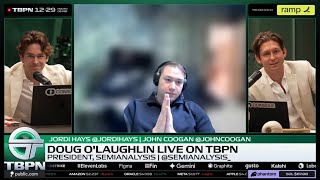
This TBPN video, published February 06, 2026,
features John Coogan, Jensen Huang, Tyler, Doug Olaflin, Max Levchin, TJ Parker
discussing CMI, ASML, TSM, META, NVDA, NOW, SAP, CDNS, SNPS, CRM, SAAS, System of record software, AMZN, GOOG, MSFT, AFRM, HIMS, NVO, Pharmacy benefit managers, OFRM.
16 trade ideas extracted by AI with direction and confidence scoring.
Speakers:
John Coogan,
Jensen Huang,
Tyler,
Doug Olaflin,
Max Levchin,
TJ Parker
· Tickers:
CMI,
ASML,
TSM,
META,
NVDA,
NOW,
SAP,
CDNS,
SNPS,
CRM,
SAAS,
System of record software,
AMZN,
GOOG,
MSFT,
AFRM,
HIMS,
NVO,
Pharmacy benefit managers,
OFRM