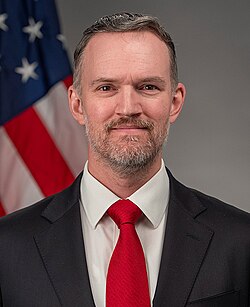
Jamieson Greer 1.0 14 ideas

US Trade Representative
After 1 day
N/A
13/15 min ideas
After 1 week
N/A
13/15 min ideas
After 1 month
N/A
4/15 min ideas
1 winning  /  3 losing  ·  4 positions (30d)
Net: -7.4%
Recent positions
TickerDirEntryP&LDate
BA LONG $199.00 Mar 31
By sector
Stock
10 ideas -14.0%
ETF
4 ideas +12.4%
Top tickers (by frequency)
DOW 2 ideas
FXI 2 ideas
LYB 2 ideas
MP 1 ideas
BA 1 ideas
Best and worst calls
Greer explicitly stated that the U.S. wants to sell Boeings to China as part of optimizing bilateral trade. The proposed U.S.-China Board of Trade could formalize mechanisms to increase U.S. exports, including Boeing aircraft, to the Chinese market. This indicates potential growth in Boeing's sales and revenue from China, supporting a LONG view. Trade negotiations may fail, or China could resist purchasing Boeing aircraft due to geopolitical tensions or competing interests.
BA Bloomberg Markets Mar 31, 13:33
US Trade Representative
China relies on oil from Iran. The United States, we're a huge producer of both oil and LNG... I think we're more resilient on that front because we have a lot of domestic feed stocks and hydrocarbons. As Middle East conflicts drive up global oil prices, Chinese chemical and plastic manufacturers will face severe margin compression. US-based chemical companies will gain a massive structural cost advantage due to cheaper, insulated domestic natural gas and hydrocarbon feedstocks. LONG. US chemical manufacturers will capture global market share and expand margins while Asian competitors struggle with soaring input costs. A severe global recession reduces aggregate demand for plastics and chemicals, offsetting the regional cost advantage.
LYB DOW CNBC Mar 13, 16:47
US Trade Representative
"I think what you want to look is what are the feed stocks doing in China. Because some of these hydrocarbons go into the plastics industry, the chemicals industry in China. I think we're more resilient on that front because we have a lot of domestic feedstocks." The Iran conflict is disrupting cheap oil flows to China, which raises the input costs for Chinese chemical and plastics manufacturers. US chemical companies utilize domestic natural gas liquids (NGLs) as feedstocks. Because US domestic energy is abundant and insulated from Middle East shocks, US chemical producers gain a massive margin and pricing advantage over their Chinese competitors. LONG US chemical and plastics manufacturers who benefit from structurally cheaper domestic feedstocks while international competitors face supply shocks. The Iran war ends faster than expected (Greer predicts "weeks"), which would normalize global oil prices and erase the relative feedstock cost advantage for US producers.
CE DOW LYB CNBC Mar 13, 12:53
US Trade Representative
"We want to make sure that we continue to get the rare earths we need for our manufacturing base..." The USTR explicitly highlights rare earths as a critical vulnerability in the US-China economic relationship. As the US aggressively pursues Section 301 tariffs and broader decoupling (with imports already at 2004 lows), securing domestic rare earth supply chains will become a matter of national security. Domestic producers will likely receive massive government backing, subsidies, or premium pricing to ensure the US manufacturing base survives a total trade war. LONG domestic rare earth miners as strategic, government-backed assets in the ongoing geopolitical decoupling. China floods the global market with artificially cheap rare earths to bankrupt Western producers before protective tariffs can be fully implemented.
MP CNBC Mar 13, 12:53
US Trade Representative
"If we find that countries have been involved in unfair trading practices like subsidies, excess capacity... we can quantify that harm to U.S. commerce and then try to resolve that issue... you can impose a tariff or fee or something like that. We're trying to move very quickly." The US has already successfully reduced its goods deficit with China by 30% in one year. A new, fast-tracked wave of Section 301 tariffs targeting excess capacity will further compress margins for Chinese exporters. This accelerates the shifting of global supply chains away from China, weighing heavily on broad Chinese equity indices that rely on export-driven growth. SHORT Chinese large-cap equities as the trade war enters a formalized, aggressive new tariff phase. The upcoming meeting in Paris results in a surprise trade detente, sparking a massive short-covering rally in Chinese stocks.
FXI MCHI CNBC Mar 13, 12:53
US Trade Representative
"We can actually conduct these investigations under Section 301... China certainly, but also other countries, Vietnam, Southeast Asia... impose a tariff as enforcement... related to forced labor in supply chains, industrial, excessive capacity." The administration is moving from broad tariffs to targeted "Section 301" investigations. Vietnam and Southeast Asia, often seen as beneficiaries of the "China Plus One" strategy, are now explicitly in the crosshairs for transshipment and labor practices. This introduces significant regulatory risk for manufacturers in these regions exporting to the US. Avoid or Short export-dependent economies in SE Asia that have recently surged in US trade volume. Diplomatic resolutions could mitigate tariff threats; these markets may pivot successfully to non-US consumers.
VNM FXI Bloomberg Markets Feb 25, 14:09
US Trade Representative
"We're already seeing Stellantis, GM and others announce new lines and using up excess open capacity in the United States to make more cars here. So we're already seeing a good effect from the president's trade policies." The Trade Representative explicitly validates these specific companies for aligning with the administration's "reshoring" goals. By cracking down on auto imports from Mexico (which he identifies as a "big problem"), the administration is creating a protected regulatory moat for automakers that shift production domestically. Regulatory tailwinds favor legacy US automakers increasing domestic capex over importers. Retaliatory tariffs from trade partners could hurt global sales; higher labor costs in the US could compress margins despite tariff protection.
GM STLA Bloomberg Markets Feb 25, 14:09
US Trade Representative
"We're seeing things like GE has announced, you know, another $3 billion worth of investment, 1000 jobs across five states... We're seeing it in the data and we're seeing it in the actual, you know, expansion of manufacturing in America." Greer uses General Electric as the poster child for the administration's industrial policy success. When a government official explicitly names a company as the standard-bearer for their economic agenda, it implies continued political support and favorable treatment for that entity's domestic industrial projects. Long US Industrials that are onshoring capacity. Execution risk on large-scale capital projects; potential global economic slowdown reducing demand for industrial equipment.
GE Bloomberg Markets Feb 25, 14:09
US Trade Representative
Jamieson Greer (US Trade Representative) | 14 trade ideas tracked | DOW, FXI, LYB, MP, BA | YouTube | Buzzberg