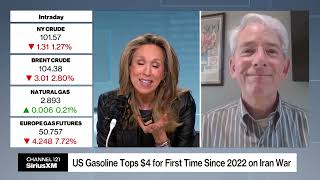
Price of Brent Should Be Higher to Reflect Situation in Iran War, Says Ellen Wald
Speakers
Ellen Wald
— Senior Fellow, Atlantic Council (Energy Expert)
Summary
- Ellen Wald argues the current price of Brent crude is disconnected from fundamentals and "should be higher" given the reality of the conflict involving Iran and its impact on international oil flows.
- She states the recent dip in Brent reflects trader "hope for... deescalation," not the actual supply/demand situation, creating a pricing anomaly versus WTI.
- The core thesis is that true energy security for the U.S. comes from strengthening "interdependence," not independence, particularly within North America (U.S., Canada, Mexico).
- She highlights the existing "incredible interdependence" with Canada for oil imports as a key reason the U.S. has fared relatively well in the current crisis.
- Wald advocates viewing energy security from a "North American" or even hemispheric perspective to build resilient supply chains for oil and critical minerals like lithium.
- While the U.S. is insulated from physical supply shortages, it is not insulated from global price shocks, which drive domestic inflation.
- Higher oil prices translate broadly into the economy, increasing costs for gasoline, food (via fertilizers), and creating broader inflationary pressure.
- She notes that even after the current conflict ends, oil prices may not return to previous lows, implying a structurally higher floor.
Ideas
Wald explicitly states "the price of Brent really should be higher" as it is not reflecting the reality of the conflict's impact on oil flows and what buyers are actually paying internationally. She attributes its recent decline to trader sentiment hoping for de-escalation. The market price (Brent ~$104.50) is being set by geopolitical sentiment rather than physical supply fundamentals. This creates a disconnect where the traded price is below the level implied by the actual supply situation. WATCH because this presents a potential mispricing setup. If the hoped-for de-escalation does not materialize or the physical market tightens further, the price of Brent would be expected to rise sharply to correct this disconnect. An actual, credible geopolitical de-escalation occurs, validating the current market sentiment and bringing more oil to market.
Up Next



This Bloomberg Markets video, published April 01, 2026, features Ellen Wald discussing BRENT. 1 trade idea extracted by AI with direction and confidence scoring.
Speakers: Ellen Wald · Tickers: BRENT