Mad Money 04/08/26 | Audio Only
Speakers
Jim Cramer
— Host, Mad Money
George Kurtz
— Founder and CEO, CrowdStrike
Summary
- Market surged on hopes of a Middle East ceasefire, with the Dow up 1,325 points, S&P up 2.51%, and Nasdaq up 2.80%. Oil plunged roughly 15%, its biggest one-day drop in 6 years.
- Biggest gainers included interest-rate sensitives (e.g., Sherwin-Williams, Caterpillar, Home Depot), travel/leisure (e.g., Carnival, United Airlines), and data center-related stocks. This mix suggests investor belief that rates will come down and peace will boost economic activity.
- Caterpillar is highlighted as a multi-theme winner, benefiting from infrastructure spending, construction (if rates fall), and data center demand for its backup generators.
- Biggest losers included oil stocks (Chevron), certain tech names (Salesforce, Workday, Intuit), and memory stocks (SanDisk, Western Digital, Lam Research). Memory stocks are framed as a low-intellectual-property "tax on the system" that makes building data centers more expensive.
- Enterprise software/SaaS stocks like Salesforce are under pressure due to the narrative that AI could reduce the number of workers, thereby reducing per-seat software revenue, though the existential threat is questioned.
- The golf sector is booming. Acushnet (GOLF) is praised for steady execution and strong brands (Titleist, FootJoy), up 59% in the past year, though now expensive at 26.5x forward P/E. Callaway is seen as having run up too far, too fast after its Topgolf separation.
- CrowdStrike's partnership with Anthropic on the "Mythos" AI model demonstrates that AI (which can find vulnerabilities in minutes) increases the volume and speed of cyber attacks, thereby accelerating the need for CrowdStrike's defensive platform and creating a symbiotic, not disruptive, relationship.
- Bread Financial is analyzed as a real but cyclical and volatile lender focused on private-label/store credit cards for lower-credit-score consumers. Its earnings are lumpy, and it carries higher charge-off rates. Cleaner alternatives for various exposures are American Express (affluent), Capital One (scale), and Affirm (BNPL).
- Core investing lesson emphasized: staying invested is crucial because the biggest market gains often occur in just a few days (like today), and trying to time exits and re-entries is extremely difficult.
- Lightning round takeaways: Prefer Nucor over Commercial Metals; for crypto exposure, buy Bitcoin directly rather than miners; remain bullish on Palo Alto Networks; avoid Nike (turnaround too slow) and General Mills.
Ideas
Cramer explicitly states CAT "represents infrastructure money, construction money, and data center money" and moved up on the prospect of more infrastructure worldwide and lower rates. The stock is a direct beneficiary of multiple, simultaneous macro and secular trends: government infrastructure spending, a potential housing/construction revival if rates fall, and critical demand for backup power generators for data centers. LONG because the company has "multiple ways to win" and is a core holding for a market anticipating growth in these areas. A failure of the ceasefire reigniting geopolitical tensions and spiking oil prices, or a recession that halts infrastructure and construction spending.
Cramer says there are "multiple reasons to own this stock once you think the coast is clear," citing a potential "rush of deals" under a pro-merger administration, which generates advisory business for Goldman. The prospect of a Middle East ceasefire and calmer markets reduces systemic risk and reignites corporate M&A activity, which is a high-margin revenue stream for Goldman Sachs's investment banking division. LONG as a play on a resurgence in capital markets and merger activity in a more stable geopolitical environment. The ceasefire proves fragile, reigniting risk-off sentiment and freezing deal activity. Earnings (reported next week) could disappoint.
Cramer calls these memory-related names a "fixture and not a good one," labeling Western Digital and SanDisk as a "tax on the system" with "low intellectual property" that makes data centers more expensive. While there is high demand and a shortage of memory for data centers, these companies' business models are seen as extracting rent through price hikes rather than adding high-value innovation, which ultimately stifles the growth and profitability of the broader data center ecosystem. AVOID because they represent a low-value, cost-inflating segment of the tech stack that investors should sidestep in favor of higher-IP players. The memory shortage becomes so acute that pricing power overwhelms the negative narrative, leading to significant earnings beats and stock rallies.
Cramer states Salesforce is in a space "considered guilty until proven innocent thanks to the rise of AI" and questions how it can make as much money if AI allows for fewer workers, reducing per-seat SaaS revenue. The dominant market narrative is that AI-driven productivity gains will reduce headcount, directly threatening the per-user pricing model of SaaS companies like Salesforce, creating a persistent overhang on the stock. AVOID because the stock is caught in a negative thematic shift that outweighs its strong individual products (like agentic software and Slack), making it vulnerable to continued selling pressure. Salesforce demonstrates that its AI tools actually drive increased product adoption and higher revenue per customer, disproving the workforce reduction thesis.
Cramer says, "I'm going to have to say no. I don't have a reason to recommend General Mills." He notes its high yield (6.67%) did not stop its decline. The stock is in a downtrend with a poor near-term outlook, and its attractive dividend yield is insufficient to offset the fundamental weakness and selling pressure. AVOID due to a lack of positive catalysts and persistent negative momentum. A successful cost-cutting program or new product launches revive sales growth and investor sentiment.
Following an interview with CEO George Kurtz, Cramer concludes the relationship with Anthropic is "symbiotic," not disruptive, and that "you need" CrowdStrike to secure AI. AI models like Anthropic's Mythos can find and exploit vulnerabilities in minutes, increasing attack volume and reducing response time. This dramatically accelerates the need for CrowdStrike's defensive platform, which is a "net data creator" with a unique data moat and expertise. LONG because AI adoption is a powerful tailwind that increases the necessity and urgency of CrowdStrike's services, solidifying its competitive advantage and growth trajectory. Execution missteps, or a competitor develops a superior AI-native security platform that disrupts CrowdStrike's model.
Cramer says, "If I had to pick one right here, I go with Acushnet," citing better consistency, better brand quality (Titleist, FootJoy), and it being cheaper relative to Callaway. The golf industry is in a "boom" with more rounds played and international growth. Acushnet has demonstrated steady execution, strong brand moats, and sales growth, making it a premium but reliable play on the trend. LONG as the preferred, higher-quality operator in a structurally growing industry, though acknowledgment that the stock is not cheap after its recent run. A sharp consumer pullback reduces discretionary spending on golf equipment and apparel. The current valuation (26.5x P/E) limits near-term upside.
Cramer states, "No... the turnaround's not happening fast enough... I made a mistake." He owns it but sees no signs of a bottom yet. Despite new management, the company's operational turnaround is progressing too slowly to halt the stock's decline, making it premature to buy. AVOID until there are clear fundamental signs of improvement. It is not yet at a floor. The new management executes a faster-than-expected turnaround, driving a surprise rally.
Cramer says Bread Financial is "interesting but not compelling enough for me to recommend" over alternatives like American Express, Capital One, or Affirm. He highlights its lumpy earnings, exposure to lower-credit-score consumers, and high delinquency rates. While a real business, it is a cyclical lender with a risky customer base. Its cheap valuation (under 8x earnings) is a trap that often appears right before credit conditions deteriorate and earnings collapse. AVOID because there are "cleaner ways to play every part of this story," with better-managed, more resilient companies available in the credit card and BNPL spaces. The U.S. consumer remains resilient longer than expected, allowing Bread to sustain earnings and re-rate higher as credit fears subside.
When asked about Commercial Metals (CMC), Cramer says, "I'm going to steer you towards Nucor" and that "Nucor could be a straight shot to 200." Cramer implies a strong preference for Nucor within the steel sector, likely based on its operational strength, market position, and exposure to favorable construction and infrastructure trends. LONG as the superior stock in the industrial metals space with significant price upside potential. A severe economic slowdown crushes demand for steel, negating the bullish thesis.
When asked about Riot Platforms, Cramer says, "if you want that, you just go buy Bitcoin. And I'm happy if you go buy Bitcoin, but just don't complicate things." He views buying the direct asset (Bitcoin) as a simpler and more straightforward way to gain crypto exposure than through mining stocks, which add operational complexity and equity risk. LONG Bitcoin as the preferred, uncomplicated vehicle for crypto investment. Bitcoin price volatility and regulatory crackdowns.
Cramer says, "I do not think that this could be hurt by Anthropic... And I'm going to stand by it. I'm going to stand by [CEO] Karp. I'm not changing my mind." Similar to CrowdStrike, Palo Alto Networks is seen as resilient to disruption from AI security tools and remains a core holding in the cybersecurity sector. LONG based on confidence in its business model's durability amidst technological change. Increased competition from AI-native security platforms or market share loss to CrowdStrike.
Up Next
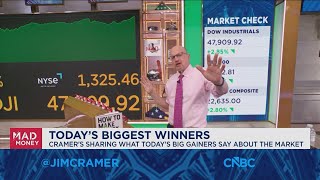




This CNBC video, published April 08, 2026, features Jim Cramer discussing CAT, GS, LRCX, WDC, CRM, GIS, CRWD, GOLF, NKE, BFH, NUE, BTC, PANW. 12 trade ideas extracted by AI with direction and confidence scoring.
Speakers: Jim Cramer · Tickers: CAT, GS, LRCX, WDC, CRM, GIS, CRWD, GOLF, NKE, BFH, NUE, BTC, PANW