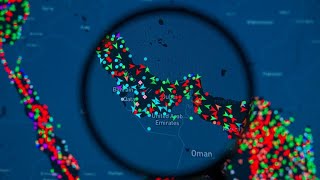
Treasury Secretary Bessent: U.S. is allowing Iranian tankers through Strait of Hormuz
Speakers
Scott Bessent
— Treasury Secretary
Brian
— Interviewer
Summary
- U.S. traded oil is touching $100 a barrel due to escalating military conflict in the Middle East and disruptions in the Strait of Hormuz.
- The global oil market is currently facing a structural deficit of 10 to 14 million barrels per day.
- To prevent oil from spiking to $150 (which would inadvertently enrich Russia), the U.S. Treasury is utilizing a record 400 million barrel SPR release, allowing Iranian oil on the water to flow, and issuing 30-day sanctions waivers for 130 million barrels of Russian oil.
- The U.S. military objective is a "generational opportunity" to permanently degrade and destroy Iran's military infrastructure, including its Navy, Air Force, and munitions factories.
Ideas
"President Trump has made it clear that his goal is to degrade and destroy the military capabilities of the regime, to destroy the navy... the air force... and now the bombing campaigns are going after the factories." Executing a sustained bombing campaign to dismantle a sovereign nation's military infrastructure requires massive expenditures on precision-guided munitions, missiles, and logistical support. The Department of Defense will be forced to rapidly replenish these depleted stockpiles, driving a surge in procurement contracts for prime defense manufacturers. LONG defense primes. The administration views this as a "generational opportunity" to neutralize Iran, indicating a sustained, high-intensity military engagement rather than a brief skirmish. The conflict ends abruptly, or Congress stalls on passing supplemental defense spending bills required to fund the stockpile replenishment.
"Shipping traffic has fallen off a cliff. It's critical for oil, for gas... By sanctioning it, [Russian oil] can go to Malaysia, Singapore, India." When the Strait of Hormuz is compromised, vessels must either wait for protective armadas or take significantly longer alternative routes. Furthermore, the rerouting of Russian and Iranian oil to new Asian buyers (India, Malaysia, Singapore) drastically increases "ton-mile demand" (the volume of oil multiplied by the distance it travels). This supply chain inefficiency directly tightens tanker capacity and drives up daily charter rates. LONG oil and product tanker operators. They are the direct beneficiaries of maritime chokepoint disruptions and the geographic reshuffling of global energy trade. The U.S. successfully and rapidly secures the Strait of Hormuz, normalizing shipping routes and collapsing the geopolitical freight premiums.
"It looks like the deficit is about 10 or 14 [million barrels], and that's before any of the ships are coming out of the straits... if oil spiked to $150, Putin was getting 70% of that, or oil stays at 95 to 100." The U.S. government is actively intervening (via SPR releases and sanctions waivers) to cap oil prices and prevent a hyper-spike to $150. However, the underlying 10-14M bbl/day deficit and severe geopolitical risk place a firm floor under the commodity. Large-cap energy producers do not need $150 oil to thrive; they generate massive, sustained free cash flow at the U.S. Treasury's "target" range of $95-$100 per barrel. LONG major energy equities. The government is absorbing the extreme tail-risk of a price explosion, but the baseline price remains highly elevated and profitable for producers. A sudden diplomatic resolution or faster-than-expected return of Gulf production could collapse the risk premium, driving oil back below $70.