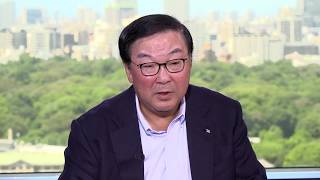
Semiconductors are fine even if interest rates rise? Focus on AI investment and big tech fundamentals | Kim Jang-yeol, Head of Research Center, Unistory Asset Management
Semiconductors are fine even if interest rates rise? Focus on AI investment and big tech fundamentals | Kim Jang-yeol, Head of Research Center, Unistory Asset Management [Global Interview]
Watch on YouTube ↗
|
August 30, 2026 at 22:54
|
35:20
|
3PRO TV (삼프로TV)
Ideas
Big tech can absorb one rate hike.
US big tech can absorb roughly one 25bp Fed hike because AI capex economics remain intact: hyperscaler ROIC is around 20%, above weighted average cost of capital, corporate bond issuance is being met with roughly 4x demand, and rate sensitivity from July peaks was modest. Critical debt stress would require 10-year yields near 5-6%, two consecutive hikes, or 50bp plus oil at $120, and those conditions are not present now.
Oracle's debt-funded capex makes it risky.
Oracle is identified as the weak link in big tech AI capex financing because it is funding nearly all of its investment with debt, unlike Amazon, Alphabet and Meta which debt-fund only about 20-30% of capex. This high leverage makes Oracle persistently risky and explains why its stock does not rebound even when other big tech holds up.
Watch 10-year yield nearing five-to-six percent.
Kim identifies the critical threshold as the 10-year Treasury yield approaching 5-6%; at that point big tech debt-funded AI capex becomes stressed and could break the equity story. He believes policymakers also know this threshold and would respond, so it is the key level to monitor for whether the AI and big tech trade can continue absorbing higher rates.
AI semiconductor rate fears are overdone.
At Treasury yields roughly equal to late July, US AI/semiconductor leaders such as Nvidia and Micron are actually higher, and SK hynix ADR has reacted appropriately to fundamentals; the speaker argues rate-driven AI semiconductor worries are overdone outside Korea's local market.
Korean memory semi fundamentals improved; oversold.
Samsung Electronics and SK hynix have improved fundamentals versus late July: Samsung said supply shortages may persist through 2028 and LTA coverage is being raised above the prior 60-70% range, yet their shares sit below late-July levels while Micron, Nvidia and US big tech are higher at similar Treasury yields. Kim sees Korea as overreacting to rate fears and ignoring improving memory fundamentals.
Watch Nvidia $180, Alphabet $300 levels.
Kim uses Nvidia and Alphabet as the two fundamental barometers for AI capex economics. If Nvidia threatens the roughly $180 moving average and Alphabet breaks down through about $300, he would treat that as a warning that the AI trade has a real issue; currently these levels are far enough away that rate-hike fears are overblown.
Amazon rallies on Anthropic legal win.
Amazon rose 4% on Friday despite rate concerns because Anthropic, its strategic AI partner and investee, won a legal victory against the US Department of Defense supply-chain restriction. Kim interprets this as the market focusing on company-specific AI fundamentals rather than macro rates, making Amazon a positive fundamental story tied to Anthropic's revival.
This 3PRO TV (삼프로TV) video, published August 30, 2026,
features Kim Jang-yeol
discussing US Big Tech, ORCL, US10Y, AI Semiconductors, 005930.KS, 000660.KS, NVDA, GOOGL, AMZN.
7 trade ideas extracted by AI with direction and confidence scoring.
Speakers:
Kim Jang-yeol
· Tickers:
US Big Tech,
ORCL,
US10Y,
AI Semiconductors,
005930.KS,
000660.KS,
NVDA,
GOOGL,
AMZN