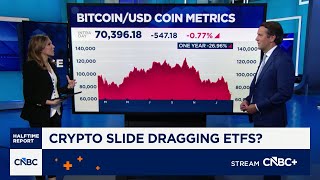
Bitcoin is not digital gold and behaves like a speculative financial instrument: Stifel's Bannister
Speakers
Barry Bannister
— Chief Equity Strategist, Stifel
Summary
- Bitcoin is projected to potentially fall to the $38,000–$40,000 range, driven by a breakdown in its historical correlations with the dollar and money supply.
- The asset is no longer behaving as "digital gold" or a hedge against currency debasement but rather as a highly speculative, liquidity-dependent tech stock.
- Broad equity markets face downside risk as valuation multiples are unsustainable without aggressive Fed rate cuts, which Bannister does not expect.
- The consensus bet on a "smooth rotation" into cyclical sectors (Industrials, Financials) is flawed because consumer buying power is weakening due to slowing wage growth and soft labor data.
Ideas
Bitcoin is not acting like digital gold; it is behaving like an overextended, speculative tech stock. Bannister warns it could fall to the $38,000–$40,000 level. Historically, Bitcoin rose when the Dollar fell or when global money supply expanded. Recently, these correlations have inverted or broken. It is now purely a "liquidity instrument" that requires ever-cheaper interest rates to survive. Since the Fed is unlikely to cut rates as aggressively as the market wants, the primary driver for Bitcoin is vanishing. Technical analysis of the last three major drawdowns over 15 years suggests they all stopped at a specific trendline, which currently sits around $38,000. A sudden, unexpected return to aggressive quantitative easing or Fed rate cuts could invalidate the liquidity crunch thesis.
The market is currently betting on a "smooth rotation" out of tech and into cyclical sectors, but Bannister argues this trade is premature. Cyclical stocks depend on a healthy economy and consumer buying power. Currently, wage growth is slowing, hours worked are not cooperating, and job creation is weak. There is no fundamental "buying power" to support a rally in these sectors yet. Weak monthly job reports and slowing wage growth data contradict the narrative of a robust economic rotation. If economic data suddenly improves or inflation drops faster than expected, allowing real wage growth to recover.