Weak two-year note auction reflects a 'bunker mentality' right now, says Wells Fargo's Schumacher
Speakers
Michael Schumacher
— Head of Macro Strategy, Wells Fargo
Summary
- The weak 2-year Treasury note auction reflects a "bunker mentality" among bond investors, spooked by extreme uncertainty over the Fed's next move (hike or cut).
- There is a current disconnect: bond markets are cautious, while equities appear more resilient, possibly because inflation can be supportive for corporate earnings.
- The Fed's hands are largely tied; its best choice is to sit, wait for more data, and maintain liquidity (e.g., continuing T-bill purchases) without changing the policy rate.
- A stagflationary environment would be "terrible" for all risk assets (equities) and not very good for fixed income.
- We are not in stagflation yet; it is defined as sub-1% GDP growth, which would feel "grim" and could be a quarter or two away.
- The market has already been penalizing the economy (e.g., 30-year mortgage near 6.40%), limiting the Fed's need or ability to act.
- The S&P 500's recent ~8% pullback is within the range of a normal annual average decline (~10%), providing context for current equity volatility.
Ideas
The speaker states it's "not a great environment to buy a really short term Treasury security" due to uncertainty on the Fed's next move (hike or cut), which has investors "spooked." This uncertainty creates a "bunker mentality," leading to weak demand at auctions (like the cited 2-year note auction) and poor risk/reward for short-dated government bonds. The environment is explicitly unfavorable for buying, warranting an AVOID stance on the bond market, particularly short-term Treasuries. The Fed provides clarity on its policy path sooner than expected, reducing uncertainty.
The speaker notes equities may not get support from the Fed, but suggests "earnings typically do well in an inflationary environment," providing some built-in support. This creates a fragile equilibrium. Equities are disconnected from bond market fears due to earnings optimism but face a clear and severe risk from potential stagflation, which is "terrible" for risk assets. The positive (earnings in inflation) and negative (stagflation risk) forces are in tension, making the overall outlook highly uncertain and dependent on incoming growth data. This warrants a cautious WATCH stance. GDP growth holds above 1%, averting a stagflation scare and allowing the earnings narrative to dominate.
Up Next

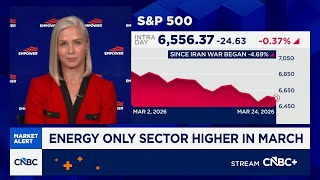
This CNBC video, published March 24, 2026, features Michael Schumacher discussing XLF, XLK. 2 trade ideas extracted by AI with direction and confidence scoring.
Speakers: Michael Schumacher · Tickers: XLF, XLK