Trump Won’t Rule Out Military Force to Acquire Greenland | Daybreak Europe 1/7/2026
Summary
Bloomberg Daybreak Europe leads with geopolitics: the White House refuses to rule out military force to acquire Greenland, Trump says Venezuela will send up to 50 million barrels of oil to the U.S., and Ukraine allies report progress on security guarantees. Market coverage highlights a pullback in Asian stocks, strength in memory chips on AI storage demand, and CES news from NVIDIA and Siemens. WisdomTree's Aneeka Gupta discusses how investors can position around Venezuela, defense, oil, the dollar, and emerging-market tech.
- White House will not rule out military force to acquire Greenland; European allies and Denmark push back.
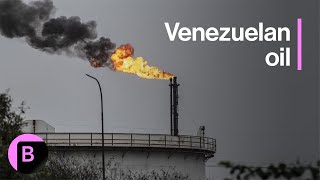
- Trump says Venezuela will send up to 50 million barrels of oil to the U.S., worth about $2.8 billion, weighing on crude.
- Ukraine allies hail progress on security guarantees and a possible multinational force, but Russian redlines remain.
- Asian equities pull back after a strong start; Japan-China tensions hit Japanese carmakers while rare-earth names gain.
- CES: NVIDIA and Siemens expand their AI partnership; NVIDIA highlights new chips and AI-factory demand.
- Memory-chip names rally on AI storage demand and shortage concerns; Samsung warns of industrywide memory price hikes.
- Aneeka Gupta sees U.S. integrated energy and defense as positioning areas, a softer dollar in 2026, and long-term downside pressure on oil.
- Market focus also includes upcoming U.S. inflation data and a potential Supreme Court tariff ruling.
Ideas
Up Next


This Bloomberg Markets video, published January 07, 2026, features Valerie Tytel, Jensen Huang, Roland Busch, Aneeka Gupta discussing DRAM, NVDA, SIEMENS, XLE, VYM, XLI, ITA, European defense sector, WTI, UUP, Korea technology sector, Taiwan technology sector, CQQQ. 8 trade ideas extracted by AI with direction and confidence scoring.
Speakers: Valerie Tytel, Jensen Huang, Roland Busch, Aneeka Gupta · Tickers: DRAM, NVDA, SIEMENS, XLE, VYM, XLI, ITA, European defense sector, WTI, UUP, Korea technology sector, Taiwan technology sector, CQQQ