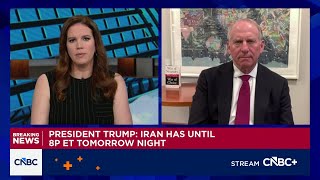
Trump Amps Up Threats as Market Hits Standstill | The Close 4/6/2026
Speakers
Kristina Hooper
— Chief Global Market Strategist, Invesco
Ryan Petersen
— CEO, Flexport
Sheila Kahyaoglu
— Senior Airlines Equity Research Analyst, Jefferies
Mark Kimmitt
— Retired Brigadier General, US Army
Mandy Xu
— Head of Derivatives Market Intelligence, Cboe Global Markets
Ernest Moniz
— Former US Secretary of Energy
Stephanie Pierce
— Deputy Head of Investments, BNY Investments
Wemimo Abbey
— Co-CEO, Esusu
Samir Goel
— Co-CEO, Esusu
Adam Breneman
— Co-Founder, The College Sports Company
Paul Caine
— President, On Location
Summary
- Kristina Hooper argues the market has not accurately priced Middle East conflict risks, seeing it as more significant than unilateral tariff events due to multiple involved players and potential for prolonged disruption.
- Hooper expects sustained elevated oil prices to pressure consumer spending and corporate earnings, citing recent economic data showing affordability strains and weak consumer cyclicals.
- Ryan Petersen details severe supply chain disruptions from the Strait of Hormuz closure, with shipping rerouted around Africa, airfreight capacity down 80-90%, and fertilizer supply as a critical, unpriced risk that could trigger food shortages and social unrest.
- Sheila Kahyaoglu highlights Kratos as a beneficiary of rising demand for affordable drones and missiles, noting the stock's 25% decline since the Iran conflict began as an attractive entry point.
- Mark Kimmitt suggests U.S. military options to reopen the Strait are limited by its party status, making allied escorts more plausible, and warns that attacking Iranian infrastructure could lead to reciprocal strikes on Gulf assets.
- Mandy Xu observes equity options traders fading the recent risk-on rally by selling upside calls, while oil options show a rare inverted skew, indicating persistent long-term hedging demand against supply disruptions.
- Ernest Moniz warns that damage to Gulf energy infrastructure (e.g., Qatar's natural gas facilities) could take up to five years to repair, leading to structurally higher commodity prices and prolonged inflationary pressures.
- Stephanie Pierce advises clients to focus on portfolio resilience, diversification into global infrastructure and value, and higher-quality fixed income as a hedge against credit and rate risk.
- Esusu's co-CEOs emphasize rent reporting as a key tool for building credit, particularly for younger generations, and note a partnership with Zillow to democratize access.
- Adam Breneman discusses the potential impact of a Trump executive order on college sports transfers, while noting that NIL payments have strengthened the product by keeping athletes in school longer.