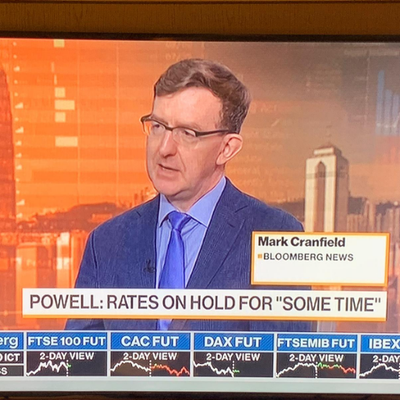
Mark Cranfield 5.3 74 ideas

Cross Asset Strategist, Bloomberg
After 1 day
53%winrate
+0.8% avg
19W / 17L · 36/45 ideas
After 1 week
57%winrate
+0.7% avg
20W / 15L · 35/45 ideas
After 1 month
53%winrate
-0.6% avg
17W / 15L · 32/45 ideas
17 winning  /  15 losing  ·  32 positions (30d)
Net: -0.6%
Recent positions
TickerDirEntryP&LDate
WTI LONG $124.68 Apr 16
QQQ LONG $634.39 Apr 15
JPM LONG $305.95 Apr 15
GS LONG $902.55 Apr 15
KBE LONG $63.49 Apr 15
SPY LONG $698.45 Apr 15
SAMSUNG LONG Apr 09
TSM LONG $362.60 Apr 09
TLT SHORT $85.85 Apr 02
WTI SHORT $133.20 Apr 02
By sector
ETF
33 ideas -0.2%
Stock
23 ideas -0.3%
currency
11 ideas +2.9%
Commodity
5 ideas -16.3%
index
2 ideas
Top tickers (by frequency)
JPY 7 ideas
50% W -0.4%
TLT 6 ideas
67% W +0.8%
TSM 4 ideas
50% W -1.1%
EWY 4 ideas
75% W +4.2%
WTI 3 ideas
Best and worst calls
Yield curve to flatten with short rates high.
Due to oil price pressures and central banks' reluctance to hike rates immediately, short-term interest rates are expected to stay higher while long-term rates may decline, leading to a flattening of the yield curve as markets price in sustained inflation risks and economic slowdown concerns.
TLT HIGH Bloomberg Markets Apr 16, 08:06
Cross Asset Strategist, Bloomberg
Oil prices elevated due to supply blockades.
Oil prices are unlikely to return to pre-war levels because the Strait of Hormuz remains effectively closed with minimal vessel traffic, and supply disruptions will persist due to damaged infrastructure and lengthy recovery times, keeping energy markets tight.
WTI HIGH Bloomberg Markets Apr 16, 08:06
Cross Asset Strategist, Bloomberg
U.S. banks strong on trading revenue.
U.S. banks like JPMorgan are reporting strong earnings with record trading revenue, indicating resilience despite geopolitical disruptions, and equity investors are comfortable with bank stocks.
GS KBE JPM HIGH Bloomberg Markets Apr 15, 08:06
Cross Asset Strategist, Bloomberg
Equities attractive due to strong earnings.
Equities, especially big cap stocks, are looking good as earnings season reinforces market strength, and investors are comfortable moving money back despite geopolitical risks, supported by decent results from companies like ASML.
QQQ SPY HIGH Bloomberg Markets Apr 15, 08:06
Cross Asset Strategist, Bloomberg
The speaker states the "underlying story is still very healthy" for major Asian tech companies like Samsung, TSMC, and Hynix, which were the big drivers pre-war. He cites Samsung's "fantastic profits," notes foreign investors are "heavy sellers" and have "a lot of rebuilding to do," and observes serious "dip buying" during the market weakness. The Iran war only interrupted a strong, fundamental tech hardware growth story centered on AI and semiconductor demand. As geopolitical risk recedes, capital is likely to flow back into these high-quality, fundamentally sound names to rebuild positions. LONG because the core earnings and demand thesis remains intact, the war was a temporary interruption, and there is significant pent-up institutional buying interest. A severe re-escalation of the Middle East conflict reinstating broad risk-off sentiment.
TSM SAMSUNG Bloomberg Markets Apr 09, 06:07
Cross Asset Strategist, Bloomberg
The speaker observed that "the oil curve is extremely inverted," with people "paying up dramatically for short-term crude in relation to long-term crude," indicating high near-term risk. The market is pricing a significant supply disruption risk tied to the binary geopolitical event (Trump's deadline). An escalation, such as strikes on Iranian infrastructure, would likely cause a immediate price spike. Watch oil closely due to the high-consequence, binary event risk. The deeply inverted curve signals trader expectation of a potential supply shock in the very near term. The deadline passes without incident or with a surprise diplomatic breakthrough, leading to a swift reversal of the risk premium and a collapse in near-term prices.
WTI Bloomberg Markets Apr 07, 06:58
Cross Asset Strategist, Bloomberg
The speaker stated it is "a very tricky time to be selling long bonds in the U.S." and that it's a "very tough week to be selling 30-year bonds," citing weak demand at a Japanese 30-year auction. High oil prices embed a lasting Middle East risk premium, which feeds inflation concerns. Concurrently, planned increases in defense spending point to more government supply. This combination makes the long end of the yield curve particularly unattractive. Avoid long-dated sovereign bonds due to poor auction demand, inflationary pressures from the conflict, and looming increases in debt supply. A rapid de-escalation in the Middle East that crushes the oil price and inflation expectations could restore demand for long-dated bonds.
TLT Bloomberg Markets Apr 07, 06:58
Cross Asset Strategist, Bloomberg
The speaker observes that in the current "war trade" regime, "oil is the only thing people seem to have any faith in at the moment," and high energy prices are "going to be very bad." The transportation sector (airlines, shipping, logistics) is highly sensitive to fuel costs. Persistently high oil prices directly erode profitability across the sector. In a market regime dominated by high and volatile energy prices, the transportation sector faces strong headwinds and is likely to underperform. A sudden and sustained drop in oil prices, or the ability of companies to fully pass on cost increases to customers.
JETS Bloomberg Markets Apr 02, 07:09
Cross Asset Strategist, Bloomberg
The speaker states that oil prices staying above $100 is a "pain point" and that markets expected an "averaging down" into a lower trading range after Trump's speech, which did not happen. The failure to get a de-escalation signal from Trump means the "war trade" is back on, with high energy prices seen as "very bad" for growth and inflationary. The prolonged closure of the Strait of Hormuz directly threatens supply. The persistence of high oil prices (above $100) is a primary negative catalyst for bonds, equities, and central bank policy, sustaining the risk-off market regime. A sudden diplomatic breakthrough that reopens the Strait of Hormuz and leads to a rapid drop in oil prices.
WTI Bloomberg Markets Apr 02, 07:09
Cross Asset Strategist, Bloomberg
The speaker notes Treasury yields are going up, and a "very bad" JGB auction made losses "a lot worse." He states this is a "bad setup" for European bonds and could be "really nasty" for upcoming Treasury auctions if the situation isn't resolved. Geopolitical uncertainty (prolonged Iran war) fuels inflation fears, driving bond selling. The weak JGB auction demonstrates poor investor appetite amid these fears, creating a negative feedback loop across global bond markets. The combination of geopolitical risk and failed auctions is driving a sustained selloff in global sovereign bonds, pushing yields higher. A rapid de-escalation in Iran that cools inflation expectations and restores demand for sovereign debt.
TLT Bloomberg Markets Apr 02, 07:09
Cross Asset Strategist, Bloomberg
The strategist states the recent move in the 2-year yield is just the early stages. If oil prices stay elevated for months, it could lead to dramatic curve flattening, forcing the Fed to seriously consider raising interest rates. A sustained energy-driven inflation shock would challenge the Fed's "look through" approach, potentially pivoting monetary policy from a neutral/hold stance back to a tightening bias. The sector faces a significant re-pricing risk of the interest rate outlook. The trajectory of the conflict and oil prices is critical for determining the duration and intensity of this pressure. A rapid resolution to the conflict and a sharp drop in energy prices would allow the Fed to maintain its current cautious stance.
XLF Bloomberg Markets Mar 19, 08:09
Cross Asset Strategist, Bloomberg
Mark Cranfield (Cross Asset Strategist, Bloomberg) | 74 trade ideas tracked | JPY, TLT, TSM, EWY, WTI | YouTube | Buzzberg