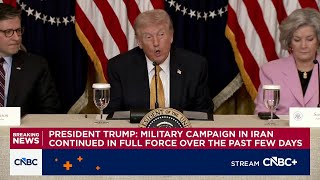
Trump Says Some Countries Will Help Secure Strait of Hormuz
Speakers
Donald Trump
— President of the United States
Summary
- The US reliance on the Strait of Hormuz for oil imports has fallen to less than 1 percent, insulating the domestic economy from direct supply shocks.
- Asian economies remain highly dependent on the strait for energy, with Japan importing 95 percent, China 90 percent, and South Korea 35 percent of their oil through this chokepoint.
- The speaker highlights the fragility of the strait, noting that a single small missile or terrorist act could disrupt global shipping.
- There is a clear geopolitical shift toward transactional alliances, with the US demanding that allied nations provide their own military assets (such as minesweepers) to secure international sea lanes rather than relying solely on US protection.
Ideas
we get less than 1% of our oil from the strait and some countries get much more. Japan gets 95%, China gets 90%. Many of the Europeans get quite a quite a bit. South Korea gets 35%. Asian manufacturing economies are critically exposed to Middle Eastern energy flows. If the US reduces its naval presence in the region and forces these countries to secure their own supply lines, the risk premium on their energy imports will skyrocket. Any disruption in the strait would cause severe energy inflation for these nations, crushing industrial margins and slowing their broader economic growth compared to energy-independent nations like the US. AVOID. Heavy reliance on imported energy through vulnerable chokepoints creates a structural headwind for Asian equities if US naval hegemony recedes. These countries could successfully transition to alternative energy sources, secure overland pipelines (in China's case), or negotiate bilateral security agreements that keep energy flowing cheaply.
literally a single terrorist can put something in the water or shoot something or shoot a missile, a small missile, and it's fairly close range because it is a tight area and which is one of the reasons they've always used that as a weapon. The Strait of Hormuz remains a highly vulnerable chokepoint for global energy markets. While the US imports less than 1 percent of its oil from this region, oil is a globally priced commodity. If a disruption occurs, global crude prices will spike. Large US domestic oil producers will capture massive margin expansion from higher global prices without facing the physical supply chain risks and geopolitical threats that Middle Eastern producers face. LONG. US exploration and production companies offer a geopolitical hedge, benefiting from global energy price spikes while operating in secure domestic basins. A rapid de-escalation of Middle Eastern tensions or a global macroeconomic slowdown could suppress baseline oil demand and prices.
what we want to know, do you have any minesweepers? Well, what I would rather not get involved, sir. I said for You mean for 40 years we're protecting you and you don't want to get involved... I've been a big critic of all of the protecting of countries, because I know that we'll protect them. And if ever needed, if we ever needed help, they won't be there for us. The US is signaling a structural shift away from unilaterally policing global sea lanes, demanding that allies share the military burden. Nations that have historically relied on the US security umbrella (like Japan, South Korea, and European allies) will be forced to rapidly expand their own naval and maritime security capabilities. This creates a massive export opportunity for US defense primes that manufacture naval systems, missile defense, and maritime surveillance equipment. LONG. Defense contractors with strong foreign military sales pipelines will see increased orders as allied nations are forced to build sovereign military capabilities. Allied nations could choose to procure defense equipment from their own domestic manufacturers rather than buying from US primes, or US export restrictions could delay sales.