How SpaceX Humiliated Wall Street

Watch on YouTube ↗  |  June 13, 2026 at 22:00  |  40:36  |  Patrick Boyle
Speakers
Patrick Boyle — Host / Hedge Fund Manager and Finance Professor

Summary

Patrick Boyle argues that the 23-year era of US public equity contraction is ending as AI capex turns big tech into asset-heavy capital raisers. He examines SpaceX's record $1.78T IPO, its $75B raise, its $28.5T TAM claim, its $235B cash gap, and the weak shareholder rights attached to the deal. He concludes SpaceX is priced for perfection and uses the Cisco 2000 analogy to warn about buying at extreme valuations, while noting the broader market can absorb the new equity supply.

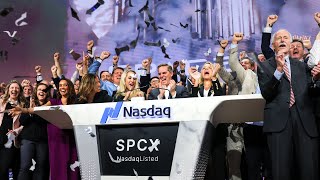
  • SpaceX priced its IPO at $135 per share, raising about $75B at a $1.78T valuation, the largest IPO ever.
  • The video says the public equity market has shifted from buybacks and shrinking share counts to a wave of new issuance driven by AI infrastructure spending.
  • Goldman Sachs forecasts up to $675B of new IPO and follow-on equity volume this year.
  • SpaceX's prospectus contains a $28.5T TAM and a reported $235B cash gap through 2030, with $20B of the raise refinancing Twitter/xAI debt.
  • SpaceX gave retail investors a large allocation and relies on fast index inclusion while offering weak shareholder rights.
  • Patrick Boyle argues the market can absorb the issuance but SpaceX itself is valued at over 90x trailing revenues and is priced for perfection.
  • The video compares high-valuation enthusiasm to Cisco in 2000, where buyers at the top waited over 25 years to break even.
Ideas
Patrick Boyle Host / Hedge Fund Manager and Finance Professor 9:32
SpaceX IPO priced for perfection; avoid.
SpaceX's record IPO at $1.78T ($135/share) is priced for perfection: it is valued above 90x trailing revenues, loses money on a massive scale, claims a $28.5T TAM that implies implausible spending, faces an approximately $235B cash gap through 2030, and only about $75B of new capital covers less than a third of commitments while $20B refinances Twitter/xAI debt. Shareholder rights are weak due to dual-class shares, Texas law, mandatory arbitration, and no class actions, and the Cisco 2000 analogy shows even a great company bought at a top valuation can take decades to break even. Avoid.
Patrick Boyle Host / Hedge Fund Manager and Finance Professor 27:13
Meta capex shift dilutes; avoid.
Meta's AI capex, forecast at up to $145B a year, has forced it from being the poster child of huge buybacks into raising capital through its largest-ever bond deal, a $27B private credit deal with Blue Owl, and reportedly considering tens of billions of new equity. Investors reacted negatively, with the stock falling almost 7% on the equity-sale report, because share count growth and dilution break the prior buyback narrative.
Patrick Boyle Host / Hedge Fund Manager and Finance Professor 35:43
Equity issuance wave absorbable; buyback tailwind over.
The record $675B wave of new equity issuance from SpaceX, Anthropic, OpenAI, Alphabet, Meta, and others should not break the US stock market because S&P 500 companies already issue about $1.7T of stock per year, roughly $140B per month; the market can absorb it. The key shift is that the 23-year era of shrinking share counts and buyback tailwinds is over, so equities no longer get that automatic mechanical support.
Up Next

This Patrick Boyle video, published June 13, 2026, features Patrick Boyle discussing SPCX, META, SPY. 3 trade ideas extracted by AI with direction and confidence scoring.

Speakers: Patrick Boyle  · Tickers: SPCX, META, SPY