Ideas
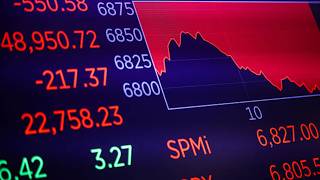
Bitcoin downtrend breaks confidence; avoid.
Bitcoin broke below $65,000 and erased much of its post-election rally, with forced selling feeding on itself, crypto market cap roughly halving, and investor confidence badly damaged. The speaker says the bottom is unpredictable and cites Stifel's $38,000 downside scenario; JP Morgan's longer-term preference for bitcoin over gold is noted but not enough to offset the broken supply-demand backdrop.
AI infrastructure demand remains strong; selloff overdone.
The AI-infrastructure trade remains fundamentally supported despite the software-led selloff: Google and Amazon are increasing capex, data centers still need more HBM, packaging substrates, power, thermal and networking equipment, memory operating margins are around 60%, and TSMC is expanding advanced capacity. The speaker argues the semiconductor weakness is driven more by fear and positioning than by deteriorating AI demand.
Data centers boost fuel-cell demand.
The speaker argues fuel-cell/power names should benefit from AI data-center electricity demand, so Bloom Energy's earlier decline looked inconsistent with the bullish AI capex narrative. After earnings guidance signaled a quantum jump, the stock surged in the aftermarket, reinforcing the view that data-center power demand is a real tailwind.
Software selloff overdone; wait for earnings.
Software/SaaS stocks have sold off sharply on fears that Claude Cowork and AI agents will replace software, but the speaker argues the market reaction is excessive: AI tools generally execute through existing software, not replace it wholesale, while coding jobs and some low-value software will shrink. The next Salesforce, ServiceNow and Workday earnings are needed to differentiate winners from losers, so this is a developing watch item rather than a clean long.
Tech relative weakness may be bottoming.
Tech relative performance has fallen to its weakest level since 2009, and the speaker argues the fear-driven decline is unlikely to keep grinding lower indefinitely; he expects a stabilization phase where tech bottoms and consolidates, even though the exact timing is uncertain.
Alphabet benefits from TPU and strong cloud.
Alphabet reported strong revenue, EPS and cloud metrics, with Gemini/Cloud integration lifting partner revenue and contracts, and its TPU strategy gives it a cost advantage amid GPU and memory shortages. The market bought the dip because Alphabet is seen as a chip-shortage winner, and TD Cowen called it the start of Alphabet's golden era. The speaker views Alphabet as relatively strong and supported.
TSMC Japan fab confirms AI demand.
TSMC is investing $17 billion in a third Japan fab, including advanced 3nm capacity. The speaker says such a large commitment would not happen if AI and semiconductor demand were truly deteriorating, so it supports the case that AI hardware spending remains healthy.
Korean memory is deeply undervalued.
US institutions are highlighting Korean equities as cheap within emerging markets, and Samsung Electronics and SK hynix trade at less than 10x PER despite very large operating profits, supporting emerging-market fund flows toward Korea. The speaker flags a risk: HP and Dell are testing Chinese CXMT memory because conventional memory is scarce, which could pressure the Korean memory thesis.
Optical transceiver demand expectations remain intact.
Coherent's results initially hit the stock but it recovered, and Lumentum rose after its report, showing the market still expects demand for optical transceivers and optical communications tied to AI data-center buildouts. The speaker presents this as a supported part of the AI infrastructure trade.
Low-tariff consumer brands outperform high-tariff peers.
Consumer-brand charts are splitting by US tariff exposure: Tapestry and Ralph Lauren are relatively insulated and Coach is resonating with younger consumers, while Estee Lauder and Capri Holdings remain more exposed to tariff-related uncertainty. The speaker treats this as a relative stock-selection framework rather than a broad sector call.
Low-tariff consumer brands outperform high-tariff peers.
Consumer-brand charts are splitting by US tariff exposure: Tapestry and Ralph Lauren are relatively insulated and Coach is resonating with younger consumers, while Estee Lauder and Capri Holdings remain more exposed to tariff-related uncertainty. The speaker treats this as a relative stock-selection framework rather than a broad sector call.
This 3PRO TV (삼프로TV) video, published February 05, 2026,
features Park Myung-sung
discussing BTC, SMH, BE, Software/SaaS sector, XLK, GOOGL, TSM, 005930.KS, 000660.KS, EWY, COHR, LITE, TPR, RL, EL, CPRI.
11 trade ideas extracted by AI with direction and confidence scoring.
Speakers:
Park Myung-sung
· Tickers:
BTC,
SMH,
BE,
Software/SaaS sector,
XLK,
GOOGL,
TSM,
005930.KS,
000660.KS,
EWY,
COHR,
LITE,
TPR,
RL,
EL,
CPRI