Bond market saying Fed can't cut rates into higher oil prices, says One Point BFG's Peter Boockvar
Speakers
Peter Boockvar
— Chief Investment Officer, BFG Wealth Partners
Andrew Slimmon
— Senior Portfolio Manager, Morgan Stanley Investment Management
Summary
- The bond market is aggressively repricing interest rate expectations, moving from pricing in three cuts to potentially just one, driven by a spike in oil prices and sticky inflation.
- Private Credit is showing signs of stress, particularly in healthcare and consumer product loans, as high rates pressure lower-quality balance sheets.
- A strengthening US Dollar is shifting capital flows back into large-cap US equities, reversing the recent trend favoring international stocks and commodities.
- There is a divergence in views on Energy: Boockvar remains bullish on fundamentals, while Slimmon warns of "tiredness" in energy stocks despite rising oil prices.
Ideas
Boockvar notes that private credit involves "lower quality credits" that are "much more sensitive to the economy." He cites Fitch data showing rising defaults in healthcare providers and consumer products within these portfolios. Private credit firms (like Blackstone and KKR) hold portfolios of floating-rate loans to smaller, highly levered companies. If rates stay higher for longer due to oil inflation, these borrowers face a "maturity wall" or interest coverage crisis, leading to defaults that impair the asset values of the lenders. Avoid the sector as the "higher for longer" rate environment exposes credit quality issues in 2020-2021 vintage loans. The economy remains resilient enough to support debt service; the Fed cuts rates sooner than expected.
"We're having a strengthening of the dollar... on a relative basis, you're seeing more money come back into kind of the very large US stocks." A strong USD acts as a headwind for international stocks and commodities (which are priced in dollars). As the "weak dollar" consensus trade unwinds, capital rotates out of Emerging Markets/Europe and seeks safety and growth in US Large Caps. Long US Large Cap Equities as a beneficiary of capital rotation driven by currency strength. The US Dollar weakens unexpectedly; US earnings disappoint.
Andrew Slimmon
Senior Portfolio Manager, Morgan Stanley Investment Management
"I'm not sure I would necessarily bottom fish in that area [software]... we're early in how that industry is going to be turned upside down." Despite recent pullbacks making valuations look cheaper, the sector faces structural disruption (likely AI-related). Buying the dip is dangerous when the fundamental business models are being challenged, suggesting the "lows" are not yet in. Avoid catching the falling knife in Software stocks. Software companies successfully pivot to AI monetization faster than expected.
Andrew Slimmon
Senior Portfolio Manager, Morgan Stanley Investment Management
"I would not chase energy... oil is up a lot. But the stocks are... not up a lot. I wonder whether that's kind of showing some tiredness already in that area." Slimmon identifies a bearish divergence: the underlying commodity (oil) is rallying, but the equities (energy stocks) are failing to follow suit. This price action often signals buyer exhaustion and a lack of institutional conviction in the longevity of the rally. Do not chase the momentum in Energy stocks at these levels. Oil prices spike significantly higher ($100+), forcing energy stocks to catch up.
Peter Boockvar
Chief Investment Officer, BFG Wealth Partners
"I still think that there's a fundamental bull case for the price of oil... I still like oil stocks. We're long them." Despite the recent rally, Boockvar views energy as fundamentally undervalued relative to the broader market. He argues that even if geopolitical tensions (Strait of Hormuz) ease, the supply/demand structural imbalance supports higher prices. Long exposure to Energy producers (XLE) and the commodity itself (USO). Geopolitical tensions resolve quickly leading to a sharp drop in risk premium; global recession crushes demand.
Up Next
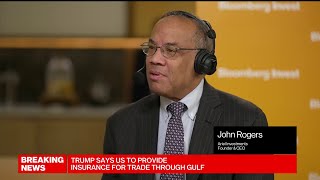
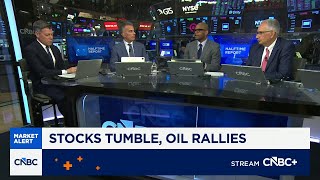


This CNBC video, published March 03, 2026, features Peter Boockvar, Andrew Slimmon discussing BX, KKR, SPY, IVV, IGV, XLE, USO. 5 trade ideas extracted by AI with direction and confidence scoring.
Speakers: Peter Boockvar, Andrew Slimmon · Tickers: BX, KKR, SPY, IVV, IGV, XLE, USO