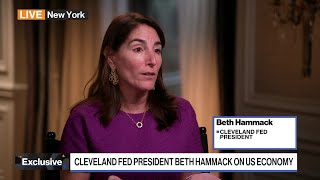
Fed's Hammack Sees Two-Sided Risks to Interest Rates
Speakers
Beth Hammack
— President of the Federal Reserve Bank of Cleveland
Summary
- The Federal Reserve sees risks to the economy as "two-sided" (balancing inflation vs. employment) rather than solely focused on inflation, though inflation remains sticky around 3% with "virtually no progress" over the last two years.
- A significant divergence is noted between PPI (Producer Price Index) and CPI (Consumer Price Index); producer prices are rising faster than consumer prices, forcing businesses to absorb costs and compress margins to protect demand.
- The labor market is stabilizing (4.3-4.4% unemployment), but a shortage of skilled tradesmen remains a primary barrier to growth in the industrial Midwest (Cleveland District).
- Speculation regarding a Fed Chair transition (potentially Kevin Warsh replacing Jay Powell) suggests market anticipation of rate cuts, but Hammack warns that policy may remain "on hold for quite some time" regardless of the Chair due to committee consensus.
Ideas
In the Cleveland district, the primary complaint is that "it's hard to find skilled laborers and tradesmen" and this shortage is a "real barrier to growth." When human labor is scarce or too expensive, industrial companies are forced to invest in capital expenditures (Capex) focused on automation and efficiency to maintain output. This directly benefits industrial automation and motion control firms, particularly those with strong Midwest industrial ties. Long Industrial Automation (Rockwell, Eaton, Parker-Hannifin) as the solution to the structural labor shortage. A recession causing a total freeze in industrial Capex.
Hammack identifies "insurance costs" as a specific, persistent driver of pricing pressure that she hears about "very regularly" from businesses. One company's "cost pressure" is another company's "revenue growth." If businesses are complaining about high premiums, it confirms that Property & Casualty (P&C) insurers possess strong pricing power and are successfully raising rates in an inflationary environment. Long P&C Insurers (Progressive, Chubb, Travelers) as beneficiaries of the sticky service inflation mentioned. Catastrophic weather events increasing payout ratios significantly.
Hammack notes that "PPI is significantly higher than CPI," meaning producer input costs are rising faster than the prices they charge consumers. She explicitly states businesses are "buffering" these costs and it is "eating into their margins." When input costs rise but companies are "nervous to pass on more" price hikes due to demand fears, earnings per share (EPS) will contract. Retailers and consumer discretionary firms with low pricing power are the most vulnerable to this margin squeeze. Short Retail (XRT) and Consumer Discretionary (XLY) to capitalize on impending earnings misses driven by margin compression. A sudden resurgence in consumer spending power allowing companies to raise prices without killing demand.
Hammack highlights "two-sided risks" regarding oil, noting that energy costs are already elevating pricing pressures and that geopolitical conflict (war) poses a risk for further spikes. Energy is identified as a key input cost that is not abating. The Fed's "wait and see" approach to supply shocks suggests they will not immediately hike rates to crush oil demand, allowing energy prices to run if geopolitical tension escalates. Long Oil (USO) or Energy Producers (XLE) as a hedge against the sticky inflation/geopolitical risk described. Demand destruction from a slowing economy causing oil prices to collapse despite supply risks.