US Q4 GDP Grows Smaller-Than-Forecast 1.4% on Shutdown Impact
Speakers
Financial Commentator
— Analyst/Host
Summary
- US Q4 GDP came in at 1.4%, significantly lower than forecast, driven by a drop in consumption and the impact of a government shutdown.
- The government shutdown subtracted approximately 1% from GDP due to accounting methods regarding unpaid wages, but this is expected to reverse in Q1 as back pay is issued.
- Inflation remains sticky with Core PCE at 3%, complicating the Federal Reserve's ability to cut rates despite slowing economic growth.
- A divergence exists in spending: Consumer consumption is falling ("running out of gas"), while business spending on software and intellectual property is rising.
Ideas
The Fed is trapped in a stagflationary dynamic (slowing growth + sticky inflation), making rate cuts less likely than the market hopes. "Look for the Fed to be cutting rates when you've got the PC core at 3% for the month of December. That's quite a ways from their target." The market may be pricing in cuts due to the weak GDP print (1.4%), but the speaker highlights that inflation (3% Core PCE) is still too high for the Fed to ease policy comfortably. This suggests volatility in rate expectations as the Fed navigates conflicting data. WATCH INTEREST RATES (Skeptical of immediate cuts). If the economy deteriorates faster than expected, the Fed may be forced to cut regardless of inflation.
The Q4 GDP miss is an accounting artifact, not a structural collapse, setting up a mechanical rebound in Q1. "The VA says the government shutdown cost one percentage point to GDP... basically they assume that since people aren't working... they can subtract their wages." The speaker explicitly states, "This will all come back because they all got back pay. So we'll see a rebound in the first quarter." The dip in data is artificial; the liquidity (back pay) eventually hit the economy, suggesting the Q1 data will surprise to the upside as the distortion reverses. LONG US CONSUMER / ECONOMY (Play the data rebound). If the consumer slowdown is structural (due to "running out of gas") rather than just shutdown-related, the rebound may be weaker than expected.
Business investment is decoupling from the slowing consumer, specifically in technology and IP. "Consumption fell off... Business spending did rise most of that for software and intellectual property." While the broader economy slowed (1.4% GDP) and consumers pulled back, corporate balance sheets continued to fund tech upgrades. This indicates relative strength and demand durability in enterprise software compared to consumer discretionary sectors. LONG SOFTWARE SECTOR. If the broader economic slowdown deepens, businesses may eventually cut capex/opex, including software spend.
Up Next


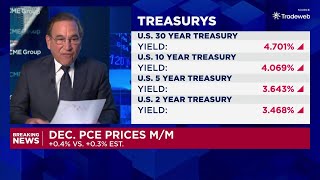


This Bloomberg Markets video, published February 20, 2026, discussing TLT, XLY, IGV. 3 trade ideas extracted by AI with direction and confidence scoring.